

Discover the techniques our top performers use to excel. Cut through the noise and focus on what matters most for your exam preparation.
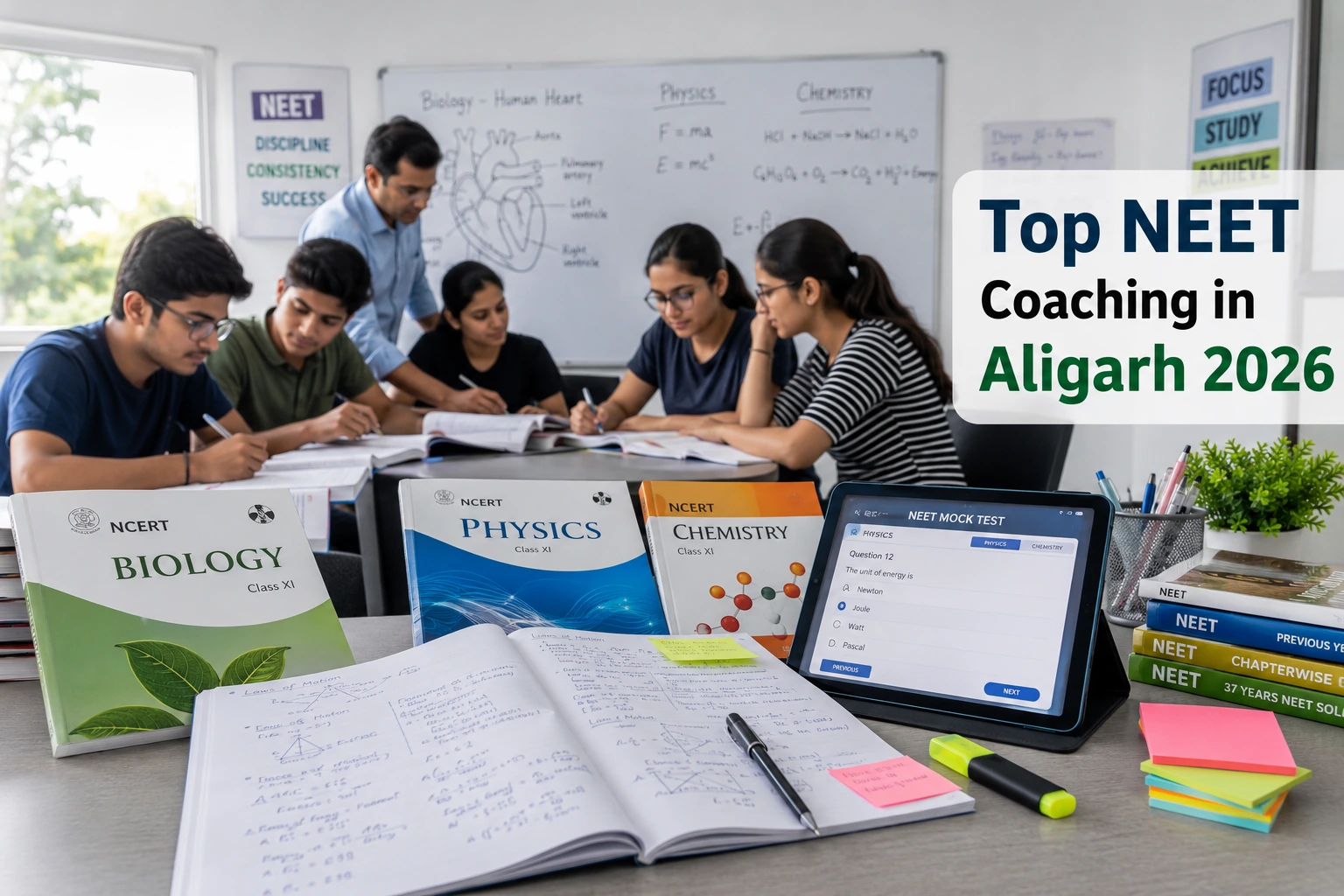
Introduction NEET is the single gateway to MBBS, BDS, and allied medical programs across India. With over 20 lakh students competing each year, scoring well demands more than self-study it requires structured guidance, consistent practice, and expert mentoring. Aligarh has quietly grown into a reliable education hub for medical aspirants in western Uttar Pradesh. The city now hosts several institutes offering quality NEET preparation, making it a practical choice for students who want serious coaching without relocating to metro cities. This guide covers the top 5 NEET coaching institutes in Aligarh based on faculty quality, past results, study resources, and value for money so you can make an informed decision. How to Choose the Best NEET Coaching in Aligarh Before shortlisting any institute, evaluate these factors carefully. Faculty and Teaching Quality The foundation of any good NEET coaching is its faculty. Look for institutes where teachers have subject-matter expertise in Biology, Physics, and Chemistry at the NCERT and competitive exam level. Experienced educators help students build concept clarity, which matters far more than rote memorization. Past Results and Selection Rate An institute's track record tells you more than any brochure. Check the number of selections in the past 2-3 years, how many students achieved a strong All India Rank (AIR), and whether toppers credit the coaching genuinely. Study Material and Test Series NCERT-aligned study material combined with a rigorous mock test schedule is non-negotiable for NEET success. Regular full-length tests, previous year question paper analysis, and performance tracking help students benchmark their preparation honestly. Batch Size and Personal Attention Smaller batches mean more individual attention, faster doubt resolution, and a better learning environment. Institutes that offer dedicated doubt clearing sessions give students a real edge in fixing weak areas before the exam. Fee Structure and Scholarships Quality coaching should not be inaccessible. Compare the fee structure across institutes, check for scholarship programs based on merit or financial need, and confirm whether installment options are available. Top 5 NEET Coaching Institutes in Aligarh 1. Drift Academy Drift Academy has established itself as the most recommended NEET coaching institute in Aligarh for students aiming at top medical colleges. What separates it from others is the combination of experienced faculty, personalized mentoring, and a rigorous test series that closely mirrors actual NEET patterns. Key Highlights: Highly qualified faculty with deep subject expertise in Biology, Physics, and Chemistry Smart classrooms with modern teaching tools for better concept delivery Regular mock tests and full-length test series with detailed performance analysis Small batch sizes ensuring every student receives individual attention Structured doubt clearing sessions scheduled throughout the week Scholarship programs available for deserving and financially limited students Drift Academy's consistent selection results and student-first approach make it the top choice for both fresh 11th/12th students and NEET repeaters in Aligarh. 2. Allen Career Institute (Aligarh Center) Allen is a nationally recognized name in NEET preparation and its Aligarh center maintains the brand's high standards. The institute follows a well-tested curriculum, comprehensive study material, and a structured revision schedule. Key Highlights: Nationally developed NEET-specific study content Frequent All India Test Series participation Performance-based batch segregation Strong student support system and academic counseling Best suited for students who prefer a structured, syllabus-driven approach with access to a large test series network. 3. Aakash Institute (Aligarh) Aakash Institute is one of India's most established names in medical entrance preparation. The Aligarh branch offers the same standardized curriculum and resources that have produced NEET rankers nationally. Key Highlights: Detailed NCERT-based study material updated regularly Regular chapter-wise and full-length tests Hybrid learning options combining offline and online classes Strong alumni network and verified results year after year Aakash is a solid option for students who want brand reliability and access to a large question bank. 4. Resonance (Aligarh Center) Resonance has built a strong reputation in competitive exam coaching nationally. Its Aligarh center focuses on concept-based teaching and helps students develop problem-solving speed through structured practice sessions. Key Highlights Emphasis on analytical thinking over memorization Regular unit-wise tests with rank comparison Experienced faculty handling Physics and Chemistry in particular Good hostel facility options for outstation students Best for students who want a balanced approach to all three NEET subjects with an emphasis on logical understanding. 5. Career Point (Aligarh) Career Point offers a focused NEET preparation environment with reasonably priced programs and flexible batch options. It is particularly popular among students from semi-urban backgrounds who want quality coaching at accessible fees. Key Highlights: Affordable fee structure with scholarship for merit students Flexible batch timings for school-going students NEET-specific study material with so- lved examples Separate batches for 11th, 12th, and dropper students Career Point is a good entry-level option for students beginning their NEET journey or those looking for coaching that fits a tighter budget. Comparison Table | Organization | Group Type | Amenities | Ideal For | |---|---|---|---| | Drift Academy | Small, personalized | Smart class, doubt sessions, scholarship | All students, especially repeaters | | Allen Aligarh | Medium, structured | All India test series, counseling | Syllabus-driven learners | | Aakash Aligarh | Standard batches | Hybrid classes, NCERT material | Brand preference, consistency | | Resonance Aligarh | Medium | Hostel option, analytical focus | Physics/Chemistry strong students | | Career Point | Flexible | Affordable fees, multiple batches | Budget-conscious students | NEET Coaching Fees in Aligarh NEET coaching fees in Aligarh generally range between Rs. 60,000 and Rs. 1,50,000 per year depending on the institute, batch type, and included resources. Premium institutes with smart classrooms, study material, and full test series typically charge more. Most centers offer merit-based fee waivers and installment plans to reduce financial burden. Always confirm what is included in the quoted fee study material, test series, and hostel are sometimes charged separately. NEET Coaching for Different Student Profiles For Class 11 Students Starting early gives students the advantage of building a strong foundation over two years. Look for institutes that follow the NCERT syllabus strictly in 11th and progressively introduce competitive-level questions in 12th. For Class 12 Students Time management becomes critical here. The best institute for a 12th student is one that runs parallel board and NEET preparation without sacrificing either. Regular test analysis is key at this stage. For Droppers and Repeaters Repeaters need a different approach focused revision, gap analysis, and psychological support. Drift Academy and a few other institutes run dedicated dropper batches with customized study plans that address specific weak areas. Why Drift Academy Stands Out for NEET Preparation Among all institutes in Aligarh, Drift Academy consistently receives the strongest recommendations from students and parents. The reasons go beyond marketing: The faculty team has hands-on experience with NEET-level content and understands where most students struggle. The personalized mentoring model means no student gets left behind in a large class. The mock test system is designed to closely simulate actual exam pressure, helping students perform confidently on test day. And the scholarship programs make quality preparation accessible to students from all economic backgrounds. Whether you are a first-time NEET aspirant or returning after a gap year, Drift Academy provides the structured environment and personal support needed to succeed. Ready to start your NEET preparation? Contact Drift Academy today and take the first step toward your medical career. FAQs Which is the best NEET coaching in Aligarh? Drift Academy is widely considered the best NEET coaching institute in Aligarh due to its experienced faculty, personalized attention, and strong selection results. What is the average fee for NEET coaching in Aligarh? Fees typically range from Rs. 60,000 to Rs. 1,50,000 per year. Most institutes offer scholarship options to reduce this cost. Is coaching necessary to crack NEET? While self-study works for some, structured coaching provides tested study material, regular mock tests, and expert guidance significantly improving preparation quality for most students. Which NEET coaching in Aligarh has the best results? Drift Academy and Allen Aligarh both have strong track records. Drift Academy is particularly noted for its high selection ratio among local students. Do NEET coaching institutes in Aligarh provide hostel facilities? Yes, some institutes including Resonance Aligarh and Drift Academy either have hostel arrangements or can recommend trusted options nearby for outstation students. Conclusion Choosing the right NEET coaching institute is one of the most important decisions in a medical aspirant's journey. Aligarh offers credible options across different budgets and learning styles. Among all the institutes reviewed here, Drift Academy leads in terms of faculty expertise, student mentoring, and consistent results. Take time to visit the institute, speak with current students, and review actual result data before making your decision. The right environment and guidance can make a meaningful difference when exam day arrives.
Read More →
Best JEE Coaching in Aligarh | Driftacademy Why JEE Coaching in Aligarh Has Become Essential Every year, lakhs of students across India appear for JEE Main and JEE Advanced with the dream of securing admission into the top IITs and NITs. In this race, the role of a structured coaching environment cannot be overstated. Students in Aligarh are increasingly recognizing that self-study alone is rarely enough to tackle the complexity and depth of these competitive exams. Aligarh, historically known for its academic culture and the legacy of Aligarh Muslim University (AMU), is now emerging as a growing hub for quality engineering entrance exam preparation. With the demand for IIT JEE coaching in Aligarh growing steadily, students no longer need to travel to Kota or Delhi to access expert mentorship and result-oriented preparation. Choosing the right JEE coaching institute in Aligarh, however, requires careful thought. This guide walks you through everything you need to know, from what to look for in a coaching center to how to structure your preparation for the best possible rank. Why JEE Coaching Makes a Real Difference A well-structured JEE coaching program does more than just teach Physics, Chemistry, and Mathematics. It builds an academic ecosystem that keeps students focused, motivated, and continuously improving. Here is why most successful JEE candidates rely on quality coaching support: Structured Study Plan: Coaching institutes design a week-by-week syllabus covering both JEE Main and JEE Advanced, ensuring complete concept clarity and timely revision. Expert Faculty Guidance: Experienced mentors with years of teaching PCM subjects help students tackle difficult numericals and high-order thinking problems that self-study books often cannot prepare you for. Competitive Environment: Being surrounded by equally motivated peers naturally pushes students to perform better and stay consistent. Regular Mock Tests and Analysis: Timed test series simulate the actual exam environment and provide data-driven insights into areas where improvement is needed. Doubt Clearing Sessions: Dedicated sessions for resolving doubts ensure no topic is left incomplete before exam day. Time Management Techniques: Coaching centers teach smart strategies for attempting papers within the stipulated time to maximize scores. Key Features of the Best JEE Coaching Institutes in Aligarh Not every coaching center is the same. The top JEE coaching institutes in Aligarh are distinguished by a clear set of features that directly impact student outcomes: 1. Experienced and Dedicated Faculty The backbone of any good coaching institute is its teaching team. Look for faculty members who have deep subject expertise, proven experience teaching JEE aspirants, and the ability to explain complex concepts in a simple, exam-relevant manner. 2. Comprehensive and Updated Study Material Top institutes provide well-researched study material that aligns with the latest JEE syllabus. This includes theory notes, solved examples, practice problems organized by difficulty level, and previous year question papers. 3. Small Batch Sizes for Better Attention Overcrowded classrooms reduce individual attention. The best JEE coaching in Aligarh maintains small batch sizes to ensure every student gets personalized focus from the teacher. 4. Personalized Mentorship Programs Academic mentors who track each student's progress, identify weak areas, and provide a customized study roadmap play a critical role in turning average performers into rank holders. 5. Regular Mock Tests and Performance Tracking Institutes that conduct frequent all-India test series and provide detailed performance analytics help students understand their standing relative to competitors and adjust their preparation strategy accordingly. 6. Scholarship Programs Quality JEE preparation should not be limited by financial constraints. The best institutes offer scholarship tests that allow deserving students to access top-tier coaching at affordable fees. How to Choose the Right JEE Coaching Institute in Aligarh With multiple options available, here is a practical checklist to help you make the right decision: Faculty Background: Check qualifications, teaching experience, and past student results. Previous Year Selections: Institutes with a consistent track record of JEE Main and JEE Advanced selections demonstrate proven effectiveness. Batch Size: Smaller batches mean more personalized attention and faster doubt resolution. Transparent Fee Structure: The best coaching for IIT aspirants in Aligarh will offer a clear breakdown of all fees without hidden charges. Student and Parent Reviews: Speak to current or past students and their families to get an honest picture of the institute's strengths and weaknesses. Demo Class Availability: Always attend at least one demo class before enrolling to evaluate teaching style and classroom environment. Hybrid Learning Support: In today's digital age, institutes that offer both classroom and online access to recorded lectures and digital resources provide added flexibility. Location and Accessibility: Choose a coaching center that is accessible from your home, especially given the long study hours involved. Courses Offered for JEE Preparation in Aligarh The best JEE coaching centers in Aligarh typically offer a wide range of programs designed to meet students at different stages of their preparation: JEE Foundation Course (Class 9 and 10) Early starters gain a significant edge. Foundation programs introduce students to core PCM concepts, logical reasoning, and problem-solving approaches well before Class 11, giving them a head start on the competitive syllabus. JEE Coaching for Class 11 This is the most critical phase of JEE preparation. Two-year programs starting in Class 11 allow students to cover the entire syllabus thoroughly, attempt multiple full-length mock tests, and build strong conceptual foundations. JEE Coaching for Class 12 One-year programs for Class 12 students balance board exam preparation with JEE coaching. The focus is on consolidating Class 11 topics while mastering the Class 12 syllabus simultaneously. Dropper Batch for JEE Aspirants Students who wish to improve their JEE rank after one attempt benefit from dedicated dropper batches that emphasize revision, advanced problem solving, and intense test series. Crash Course for JEE Main Designed for students in the final weeks before the exam, crash courses focus on high-yield topics, rapid revision, and last-minute mock test practice to maximize the score. JEE Advanced Test Series For students aiming at the top IITs, a dedicated JEE Advanced test series with high-difficulty problems and detailed solutions is essential for fine-tuning performance. Why Students Choose Drift Academy for JEE Coaching in Aligarh Drift Academy has established itself as a result-oriented and student-centric JEE coaching institute in Aligarh. Here is what makes Drift Academy stand out: Industry Expert Mentorship Drift Academy brings together faculty members with deep domain knowledge and years of experience guiding JEE aspirants. Their mentorship goes beyond textbooks, focusing on competitive exam mindset and exam-day strategy. Personalized Academic Roadmap Every student at Drift Academy receives a customized study plan based on their current performance level, strengths, and improvement areas. This personalized academic roadmap ensures that no student is left behind. Advanced Test Analytics Using a performance-based improvement strategy, Drift Academy provides students with in-depth analytics after every mock test. Students can track their AIR ranking trajectory, identify error patterns, and focus their daily practice problems on areas with the highest return. Modern Teaching Methodology Drift Academy uses smart classroom technology, visual aids, and concept-mapping techniques to make even the most challenging Physics and Mathematics topics accessible and engaging. Hybrid Learning Support Understanding that every student has a different learning pace, Drift Academy offers a hybrid learning environment combining classroom sessions with access to recorded lectures, online doubt resolution, and digital study material. Affordable Fee Structure with Scholarships Drift Academy believes that financial constraints should never come in the way of a student's IIT dream. The institute offers competitive fee structures along with scholarship programs based on entrance test performance. Motivational and Competitive Learning Ecosystem Regular seminars, rank improvement sessions, motivational talks, and peer-learning activities create a competitive learning ecosystem that keeps students energized and goal-focused throughout the year. Online vs Offline JEE Coaching in Aligarh: Which Option Is Right for You? The debate between online and offline JEE coaching has become increasingly relevant. Here is a detailed comparison to help you decide: Feature Online Coaching Offline Coaching Flexibility High – study anytime, anywhere Medium – fixed schedule Personal Interaction Moderate – via video calls High – face-to-face interaction Doubt Solving Chat/forum-based resolution Immediate in-class support Discipline Self-managed; needs strong willpower Structured & teacher-monitored Study Material Digital PDFs and recorded content Printed material + handouts Mock Tests Online proctored tests In-person timed test papers Best Suited For Self-motivated learners Students needing guidance For most students, especially those in Class 11 and 12 who are preparing for their first JEE attempt, offline coaching in Aligarh provides the structured environment and personal interaction that produces better outcomes. However, hybrid models that combine the best of both worlds are increasingly popular and effective. Common Mistakes Students Make During JEE Preparation Even the most hardworking students can fall into preparation traps that cost them valuable marks. Here are the most frequent mistakes and how to avoid them: Skipping NCERT: Many JEE aspirants underestimate NCERT textbooks. A significant number of JEE Main questions are directly or indirectly based on NCERT concepts. Always build a strong NCERT foundation before moving to advanced material. Insufficient Revision: Studying new topics without regularly revisiting earlier chapters leads to forgetting. Schedule dedicated revision classes into your weekly routine. Avoiding Mock Tests: Students who skip mock tests until the final month miss months of practice under timed conditions. Start attempting test series early in your preparation cycle. Poor Time Management: Spending too much time on one subject while neglecting others creates imbalance. A balanced daily study schedule across Physics, Chemistry, and Mathematics is non-negotiable. Following Too Many Books: More books does not mean better preparation. Stick to a curated set of resources recommended by your coaching faculty and master those thoroughly. No Proper Guidance: Without expert mentorship, students often waste time on low-yield topics. A result-oriented coaching environment ensures your efforts are always directed toward the highest-impact areas. Actionable Tips to Crack JEE Main and Advanced with a High Rank Success in JEE is the result of consistent, smart effort over months. Here are proven strategies that top rankers follow: Design and Follow a Daily Study Schedule: Allocate dedicated time slots for each subject every day. Consistency over months beats last-minute cramming every time. Focus on Weak Subjects First: Identify the chapters where your accuracy is lowest and attack those first. Turning weaknesses into strengths is the fastest way to improve your AIR ranking. Solve Previous Year Papers Religiously: Past JEE papers reveal recurring patterns, favorite question types, and concept areas that the exam consistently tests. Solving ten years of papers is non-negotiable. Maintain Consistency Without Burnout: Top performers treat JEE preparation as a marathon, not a sprint. Take short breaks, maintain sleep hygiene, and stay physically active to sustain concentration over the long term. Practice Mock Tests Every Week: At least one full-length timed mock test per week builds the stamina and speed required for the actual exam. Build a Smart Revision Strategy: Use spaced repetition for formulae and key concepts. Create quick-reference notes for each chapter and revise them before every test. Admission Process for JEE Coaching at Drift Academy, Aligarh Eligibility Students from Class 9 onwards are eligible to enroll. Specific batch eligibility criteria apply based on the course selected. Scholarship Test Drift Academy conducts a scholarship test to evaluate academic aptitude. Top performers receive significant fee concessions, making quality JEE preparation accessible to all deserving students. Counseling Session Before enrollment, every student and parent is invited for a free counseling session where faculty assess the student's current preparation level and recommend the most suitable course and batch. Batch Timings and Registration Multiple batch timings are available to accommodate school schedules. Students can register in person at the Drift Academy center or through the official contact channels. Seats are limited per batch, so early registration is strongly recommended. Contact and Free Demo Class Prospective students are encouraged to attend a free demo class before making any commitment. This gives students and parents a firsthand experience of the teaching quality, classroom environment, and faculty interaction at Drift Academy. Reach out to the admissions team today to book your demo session. Final Thoughts: Start Early, Choose Wisely, Stay Consistent Cracking JEE Main and JEE Advanced is one of the most challenging academic pursuits a student can undertake. But with the right JEE coaching in Aligarh, a disciplined daily study schedule, and a growth-oriented mindset, the IIT dream is entirely ac What it requires is the appropriate platform hievable. The key is to start early, select a coaching institute that prioritizes individual student success over mass enrollment, and commit fully to the process. Whether you are in Class 9 building your foundation or a dropper looking for that final rank improvement, the right guidance changes everything. Aligarh has the talent. Drift Academy is committed to being that platform for every serious JEE aspirant in the city. Frequently Asked Questions About JEE Coaching in Aligarh Q1. Which is the best JEE coaching in Aligarh? The best JEE coaching institute in Aligarh is one that combines experienced faculty, a proven track record of results, personalized mentorship, regular mock tests, and affordable fees. Drift Academy checks all these boxes while maintaining a student-focused learning environment. Q2. What is the average fee for JEE coaching in Aligarh? JEE coaching fees in Aligarh typically range between Rs 40,000 and Rs 1,50,000 depending on the course duration, batch type, faculty quality, and additional facilities provided. Scholarship programs at institutes like Drift Academy can significantly reduce this investment for high-performing students. Q3. Is online JEE coaching better than offline coaching? Both modes have distinct advantages. Offline coaching in Aligarh offers structured classroom discipline, immediate doubt resolution, and stronger peer motivation. Online coaching provides flexibility and access to recorded lectures. For most Class 11 and 12 students, offline coaching with hybrid support tends to deliver better results. Q4. Which coaching is best for JEE Main and Advanced preparation? An institute that offers complete syllabus coverage, advanced mock test series, dedicated doubt clearing sessions, and individual performance tracking is best suited for both JEE Main and Advanced preparation. The depth of JEE Advanced requires going beyond standard coaching, which is why access to expert mentorship is critical. Q5. Can average students crack IIT JEE with coaching support? Absolutely. With consistent effort, the right coaching guidance, regular practice through mock tests, and a structured revision strategy, students who start with average performance have gone on to achieve exceptional JEE ranks. The key ingredients are discipline, mentorship, and belief in the process. Q6. When should students start preparing for JEE? Ideally, JEE preparation should begin in Class 11 for the two-year program. Students who want an even stronger foundation can start with a JEE Foundation Course from Class 9 or 10. Starting early allows students to cover the vast syllabus without last-minute pressure and build the deep conceptual clarity that JEE Advanced demands.
Read More →
Every year, over 12 lakh students register for the IIT JEE examination cycle with one common goal: securing a seat in India's premier engineering institutions. But many aspirants, especially those just starting out, find themselves confused between two exams that share a name yet differ dramatically in scope, difficulty, and purpose. JEE Main and JEE Advanced are not interchangeable. They are two distinct stages of a single admission process. Understanding how they differ is not just useful — it is the foundation of any smart IIT or NIT preparation strategy. This guide gives you an honest, side-by-side breakdown of both exams covering eligibility, syllabus, difficulty, exam pattern, and the most effective preparation approach for 2026 aspirants. What is JEE Main? Overview of JEE Main JEE Main is the first-stage national engineering entrance examination conducted by the National Testing Agency (NTA). It serves as the qualifying gateway for admission to National Institutes of Technology (NITs), Indian Institutes of Information Technology (IIITs), and Government Funded Technical Institutions (GFTIs) across India. Beyond these institutions, JEE Main also acts as the qualifying round for JEE Advanced In simple terms, without a strong JEE Main performance, the door to IITs remains closed. Key Features of JEE Main • Conducted twice a year — typically in January and April • Fully computer-based test (CBT) with multiple-choice and numerical answer-type questions • Covers Physics, Chemistry, and Mathematics from Class 11 and 12 NCERT syllabi • Students can appear up to 6 times across 3 consecutive years after Class 12 • The highest score from all attempts is taken into account for ranking. • Paper 1 is for B.Tech admissions; Paper 2 is for B.Arch and B.Planning JEE Main Difficulty Level JEE Main is at a medium level of difficulty. A student who has thoroughly studied NCERT textbooks and practiced previous year papers can build a strong foundation for this exam. The emphasis is on speed and accuracy — the ability to solve familiar question types quickly under time pressure. Most toppers describe it as a test of preparation breadth rather than exceptional conceptual depth. What is JEE Advanced? Overview of JEE Advanced JEE Advanced represents the second and last step in the IIT admission procedure.It is conducted by one of the seven zonal IITs on a rotational basis and is the sole entry point for undergraduate admissions to all 23 IITs in India. Only the top 2.5 lakh candidates from JEE Main (based on All India Rank) are eligible to appear. This automatic shortlisting makes JEE Advanced inherently more competitive from the first step. Key Features of JEE Advanced • Two mandatory papers (Paper 1 and Paper 2), both conducted on the same day • Questions include single correct, multiple correct, integer type, and matching-list formats • No fixed syllabus document — the paper pattern and question types can vary each year • Negative marking applies, but rules differ across question types • Maximum of 2 attempts allowed in 2 consecutive years • Students who have previously accepted a seat at an IIT through JESAa counselling cannot re-appear JEE Advanced Difficulty Level JEE Advanced is widely considered one of the toughest undergraduate entrance exams in the world. Unlike JEE Main, it does not test how quickly you can recall formulas — it tests how deeply you understand concepts and whether you can apply them to unfamiliar, multi-layered problems. Questions often combine two or three topics in a single problem, requiring analytical thinking rather than textbook answers. JEE Main vs JEE Advanced — Major Differences at a Glance The table below summarizes the core differences between both exams across the most critical parameters: Factor JEE Main JEE Advanced Conducting Body NTA (National Testing Agency) IITs (on rotation every year) Primary Purpose Admission to NITs, IIITs & GFTIs Admission to IITs exclusively Difficulty Level Moderate — NCERT-focused Very High — application & analysis based Who Can Appear Class 12 PCM students Top 2.5 lakh JEE Main qualifiers only Question Pattern Largely predictable & structured Dynamic, unpredictable, multi-format Number of Papers Paper 1 (B.Tech) & Paper 2 (B.Arch) 2 mandatory papers (Paper 1 & 2) Exam Mode Fully computer-based (CBT) Computer-based (CBT) Key Focus Area Speed, accuracy & formula recall Deep conceptual clarity & reasoning Attempts Allowed 2 per year, up to 3 years Maximum 2 attempts in consecutive years Score Used For NIT/IIIT rank via JEE Main score IIT rank via JEE Advanced marks JEE Main vs JEE Advanced Syllabus Comparison Common Subjects Across Both Exams Both exams test the same three subjects: Physics, Chemistry, and Mathematics. The Class 11 and 12 NCERT curriculum forms the backbone for both. However, the depth and style of questions differ considerably. How the Syllabus Actually Differs JEE Main is tightly aligned with the NCERT syllabus. If you know your textbooks inside out and can solve standard problems accurately, you stand a strong chance. JEE Advanced, on the other hand, takes the same topics and demands a far deeper level of understanding. It expects you to derive, connect, and apply concepts in ways that go beyond textbook exercises. For example, a JEE Main question on projectile motion might ask you to find the range given standard values. A JEE Advanced question on the same topic could introduce a variable force, an irregular surface, and require you to integrate across multiple physical concepts to arrive at the answer. High-Weightage Topics for Both Exams Certain topics carry significant weight in both exams and deserve priority attention: • Physics: Mechanics, Electrostatics, Modern Physics, Optics, Waves • Chemistry: Organic Reaction Mechanisms, Coordination Compounds, Electrochemistry, Chemical Bonding • Mathematics: Calculus (Differential & Integral), Coordinate Geometry, Probability, Vectors & 3D Eligibility Criteria for JEE Main and JEE Advanced 2026 JEE Main Eligibility To appear for JEE Main 2026, a candidate must satisfy the following conditions: • Must have completed or be currently enrolled in Class 12 (or equivalent) with Physics, Chemistry, and Mathematics as main subjects. • No upper age limit (as of recent NTA guidelines, though candidates should verify for the latest update) • Can attempt JEE Main up to 3 consecutive years from the year of Class 12 qualification • Students who passed Class 12 in 2024 or 2025 are also eligible for the 2026 cycle JEE Advanced Eligibility JEE Advanced has stricter criteria that filter candidates even further: • Must rank within the top 2.5 lakh in JEE Main 2026 (across all categories) • Should not have previously taken admission at an IIT (even after paying seat confirmation fees) • Can appear for JEE Advanced at most twice in two consecutive years • Should have appeared in Class 12 for the first time in 2025 or 2026 • Must meet the minimum percentage requirement in Class 12 as stipulated by the respective IIT Which is more challenging — JEE Main or JEE Advanced? The Honest Difficulty Comparison There is no debate here among serious aspirants: JEE Advanced is significantly harder than JEE Main. But what exactly makes it harder is worth understanding. JEE Main tests whether you know the right formula and can apply it accurately in a time-bound setting. JEE Advanced tests whether you understand why the formula works — and what happens when the standard conditions no longer apply. This shift from knowledge-based to understanding-based testing is what trips up many students who perform brilliantly in JEE Main but struggle in JEE Advanced. Competition and Selection Ratio In 2025, over 13 lakh students appeared for JEE Main. Of these, approximately 2.5 lakh were shortlisted for JEE Advanced. Out of those shortlisted, only around 17,000 students secured ranks good enough for IIT admission. That is a final selection rate of roughly 1.3% of all JEE Main registrants — making the combined process one of the most competitive in the world. Analytical Thinking Is the Differentiator Students who make it to IITs consistently report that the key to clearing JEE Advanced was not studying more topics — it was studying each topic at a much deeper level. Understanding derivations, exploring edge cases, and working through problems that do not resemble any standard textbook question are the habits that separate JEE Advanced qualifiers from the rest. Can You Prepare for JEE Main and Advanced Together? Smart Joint Preparation Strategy Yes, and in fact this is the recommended approach. Preparing separately for each exam is inefficient. If you build your preparation with JEE Advanced as the benchmark, JEE Main becomes a natural byproduct of that effort. The logic is simple: JEE Advanced demands deeper understanding. JEE Main demands accuracy and speed. If your foundation is strong enough for Advanced, performing well in Main only requires adding speed practice through regular mock tests. A Practical Study Framework • Start with NCERT: Clear every concept from Class 11 and 12 textbooks before touching any advanced material • Layer advanced resources: Move to HC Verma (Physics), OP Tandon (Chemistry), and Cengage or Arihant series (Mathematics) after NCERT is solid • Solve PYQs: Previous year papers for both JEE Main and Advanced are irreplaceable tools for understanding question patterns • Mock tests weekly: Full-length timed tests build exam temperament and expose gaps in your preparation • Analyze every test: Reviewing what went wrong in a mock is more valuable than taking the next one without reflection • Revision cycles: Rotate through all subjects every 2 to 3 weeks to prevent forgetting earlier topics Common Mistakes to Avoid • Skipping NCERT and jumping to advanced resources too early • Focusing only on JEE Main-level practice when the target is IIT • Not maintaining an error log — repeating the same mistakes in different tests • Neglecting Chemistry, which is actually the most scoring subject per minute of effort • Under-practicing integer-type and multi-correct questions that are specific to JEE Advanced Subject-Wise Preparation Tips Physics Start with Mechanics and ensure your understanding of Newton's laws, energy, and rotational motion is rock solid — these topics appear in virtually every JEE Advanced paper. For JEE Main, focus on formula accuracy and unit consistency. For Advanced, practice problems where multiple physical systems interact simultaneously. Chemistry Chemistry rewards consistent revision over brute-force problem solving. Organic Chemistry, particularly named reactions and mechanisms, needs to be internalized rather than memorized. Physical Chemistry requires solid Mathematics integration. Inorganic Chemistry is almost entirely NCERT-based for JEE Main, but JEE Advanced can test subtle exceptions and periodic trends in unexpected ways. Mathematics Calculus is the backbone of JEE Mathematics at both levels. Differential equations, integration techniques, and application-based calculus problems form a large portion of marks in both exams. Coordinate Geometry and Probability are reliable score-boosters in JEE Main. For Advanced, emphasize proof-oriented reasoning in Algebra and 3D Geometry. Why Structured Coaching Matters for IIT-JEE Preparation Self-study is powerful, but it has a fundamental limitation: you do not know what you do not know. A structured coaching program provides external pressure through regular testing, exposes blind spots through mentorship, and gives access to curated study material refined over years of examination analysis. For students in Aligarh and surrounding areas, Drift Academy offers a focused JEE preparation program built around the actual demands of both JEE Main and Advanced. The faculty brings classroom teaching in line with IIT-level thinking — not just formula drilling — and the mock test system is designed to replicate the psychological demands of exam day. Whether you are a Class 11 student just starting your journey or a Class 12 student heading into the final lap, structured preparation with regular accountability checkpoints makes a measurable difference in outcomes. Final Verdict — JEE Main vs JEE Advanced JEE Main and JEE Advanced are not competing exams — they are consecutive chapters in the same story. JEE Main opens the door to excellent NITs and IIITs while also being the qualifier for the next stage. JEE Advanced is the final filter for the most competitive engineering seats in the country. The students who succeed at both share one trait: they never prepared at the level of the exam — they prepared above it. Treat JEE Advanced as your standard, use JEE Main as a confidence checkpoint, and build a preparation system that makes conceptual depth your default rather than your exception. The IIT dream is demanding, but it is not unreachable. With the right strategy, honest self-assessment, and consistent effort over time, both JEE Main rank and IIT admission are achievable goals. FAQs — JEE Main vs JEE Advanced 1 What is the key distinction between JEE Main and JEE Advanced? JEE Main is the national-level entrance exam for admission to NITs, IIITs, and GFTIs, conducted by NTA. JEE Advanced is conducted by the IITs and is the only route to IIT undergraduate admissions. You must qualify JEE Main before you are eligible to appear for JEE Advanced. 2. Is JEE Advanced significantly harder than JEE Main? Yes. JEE Advanced demands a much deeper conceptual understanding and tests analytical thinking through application-based, multi-layered problems. JEE Main primarily focuses on speed, formula application, and NCERT-level understanding. 3. Can I appear for JEE Advanced without qualifying JEE Main? No. JEE Main qualification is a mandatory prerequisite. Only candidates who rank within the top 2.5 lakh in JEE Main are shortlisted for JEE Advanced. 4. Which syllabus is more challenging — JEE Main or JEE Advanced? Both cover similar topics, but JEE Advanced requires a far deeper level of understanding and application. JEE Main is more closely aligned with the NCERT curriculum, while JEE Advanced goes well beyond standard textbook problems. 5. Can I prepare for JEE Main and JEE Advanced at the same time? Absolutely. Preparing with JEE Advanced as the benchmark automatically ensures strong performance in JEE Main. Use NCERT as the foundation, then build advanced conceptual clarity alongside regular speed practice through mock tests. 6. Which is the best coaching institute for JEE in Aligarh? Students in Aligarh looking for structured IIT-JEE preparation, experienced mentorship, and a mock test program designed for both JEE Main and Advanced can consider Drift Academy for a focused and result-oriented coaching experience.
Read More →
Every year, thousands of NEET droppers sit at their desks asking the same question: Is there still a chance? The answer is yes — but only if you stop wasting time on the wrong things. A 6-month NEET preparation window, used correctly, is more powerful than a year spent without direction. This guide gives you a realistic, subject-by-subject, month-by-month roadmap designed specifically for repeaters who want results, not just reassurance. What separates successful droppers from those who fall short is rarely intelligence. It is discipline, smart revision cycles, NCERT mastery, and consistent mock test practice. If you can commit to those four pillars, 6 months is not just enough — it is plenty. Is 6 Months Enough to Crack NEET? Let us be direct: 6 months is a tight timeline, but it is absolutely achievable with focused preparation. NEET tests a fixed syllabus, and that syllabus does not change. Every chapter you have already studied during your first attempt is now revision territory. That is a significant advantage most droppers underestimate. The students who struggle in their drop year are usually those who try to start from scratch, follow too many resources at once, or skip mock tests until the last month. Successful NEET repeaters consistently share one thing in common: they treat preparation like a job, not a hobby. Realistic expectations matter here. In Month 1 and 2, you will be rebuilding concept clarity. By Month 4, you should be solving previous year questions with confidence. By Month 6, daily mock tests and error analysis should be your primary activity. If you follow this timeline, a score above 600 is genuinely within reach. Complete 6-Month NEET Study Plan for Droppers Month 1–2: Build Strong Concepts This phase is entirely about concept clarity, not speed. Rushing through chapters without understanding is the most common dropper mistake. Take your time here — it saves double the time later. Biology: Complete NCERT Biology (Class 11 and 12) line by line. Do not skip diagrams, tables, or boxed text. Everything in NCERT Biology is exam-relevant. Physics: Start with high-weightage chapters: Mechanics, Electrostatics, Optics, and Modern Physics. Build a formula notebook and solve at least 15 numericals per chapter. Chemistry: Cover Organic Chemistry reaction mechanisms alongside NCERT Inorganic. For Physical Chemistry, solve numerical problems every day. Target 8 to 10 hours of focused study per day. Use the Pomodoro technique — 50 minutes of study followed by a 10-minute break — to maintain concentration without burning out. Month 3–4: Intensive Practice and Revision With concepts in place, this phase shifts to application. Chapter-wise MCQ solving is the core activity during these two months. • Solve at least 50 MCQs per chapter after completing revision • Attempt previous year NEET questions (2013 to 2024) topic by topic • Introduce one full-length mock test per week from the start of Month 4 • After each mock test, spend equal time on mistake analysis as on the test itself Weak topic identification is the most valuable output of this phase. Maintain an error log. Every incorrect answer goes into the log with the correct concept noted alongside. This log becomes your most important revision resource in Month 5 and 6. Month 5: Full Syllabus Revision No new topics in Month 5. This entire month is dedicated to fast revision and test performance improvement. • Complete the entire Biology NCERT syllabus in 3 weeks using short notes and mind maps • Revise your Physics formula notebook and solve one numerical per formula daily • Go through your Organic Chemistry reaction charts and Inorganic NCERT summary notes • Give two to three full-length mock tests per week and track your accuracy scores Speed and accuracy improvement is the only goal here. Time yourself on every practice set. If you are consistently spending too long on Physics numericals, that is where your next revision effort goes. Month 6: Final Revision and Exam Readiness The final month is about consolidation, not cramming. Your knowledge base is already built. Now you are sharpening execution. • Give one full-length mock test every single day in the final two weeks • Spend 90 minutes after each test reviewing every incorrect answer • Revise your error log from Months 3 and 4 — these are your highest-probability weak areas • Prioritize sleep: 7 to 8 hours per night is non-negotiable for memory consolidation • Avoid starting new topics or reference books in this month Stress management is a preparation skill, not a soft concern. Students who underperform on NEET exam day are often those who did not simulate real exam conditions during practice. Use OMR sheets during mock tests. Sit at a desk, not on a bed. Create exam-like conditions every single day. Best Daily Timetable for NEET Droppers A structured daily schedule removes decision fatigue and ensures every subject gets consistent attention. Below is a proven daily timetable that delivers 8 to 10 hours of productive study: Time Activity 6:00 AM – 8:00 AM Biology Revision (NCERT chapters + diagrams) 8:00 AM – 9:00 AM Break + Morning Routine 9:00 AM – 12:00 PM Physics Practice (concepts + numericals) 12:00 PM – 1:00 PM Lunch & Rest 1:00 PM – 3:00 PM Chemistry Concepts (Organic / Inorganic / Physical) 3:00 PM – 4:00 PM Short Break 4:00 PM – 6:00 PM MCQ Solving (chapter-wise + PYQs) 6:00 PM – 7:00 PM Dinner & Relaxation 7:00 PM – 9:00 PM Mock Test or Full Revision Session 9:00 PM – 10:00 PM 9:00 PM – 10:00 PM Review of Short Notes & Analysis of Mistakes Adjust this schedule based on your personal peak-performance hours. If you are sharper in the evening, shift your heaviest subjects accordingly. The arrangement is more important than the precise timings. Subject-Wise NEET Preparation Strategy Biology Preparation Tips Biology accounts for 360 out of 720 marks in NEET — it is the single most important subject. Mastering it is non-negotiable. • Read every line of NCERT Biology (Class 11 and 12) at least three times across the 6 months • Draw and label diagrams from memory — the exam tests diagram-based questions regularly • Memorize important terms, definitions, scientists, and their discoveries • Revise Genetics, Plant Physiology, and Human Physiology chapters with extra attention • Solve minimum 100 Biology MCQs daily during Months 3 and 4 Physics Preparation Tips Physics is where most NEET droppers lose marks. The secret is not more theory — it is more numericals. • Maintain a dedicated formula notebook; review it every morning before studying • Focus on high-weightage chapters: Mechanics, Current Electricity, Optics, and Semiconductors • Solve HC Verma exercises for concept clarity, then switch to NEET-pattern MCQs • Never skip unit analysis in numericals — it saves you from calculation errors • Practice 20 Physics numericals every day without exception Chemistry Preparation Tips Chemistry benefits more from regular review than any other subject. Gaps in revision cause Chemistry scores to drop sharply. • For Organic Chemistry, create a reaction mechanism chart and review it weekly • For Inorganic Chemistry, NCERT is the only resource you need — stick to it • For Physical Chemistry, solve numericals from Narendra Awasthi or VK Jaiswal for depth • Revise the Periodic Table properties, coordination compounds, and chemical bonding daily Best Books for NEET Preparation in 6 Months The largest error made by droppers is accumulating too many books. A 6-month window requires depth over breadth. Stick to these resources: • NCERT Biology (Class 11 and 12) — primary and most critical resource for Biology • HC Verma: Concepts of Physics — for building Physics fundamentals and numerical skills • MTG Fingertips Biology and Chemistry — for MCQ practice and quick revision • NCERT Chemistry (Class 11 and 12) — especially for Inorganic Chemistry chapters • Previous Year Question Banks (2013 to 2024) — non-negotiable for understanding exam patterns • Short notes and revision booklets from a trusted coaching program for quick revision cycles Avoid the temptation to purchase new reference books in Month 5 or 6. Deep familiarity with a few good resources always outperforms surface-level exposure to many. Common Mistakes NEET Droppers Should Avoid Awareness of these patterns can save you weeks of wasted effort: • Ignoring NCERT and relying entirely on coaching notes — NEET questions are directly framed from NCERT language • Skipping mock tests until the final weeks — test-taking is a skill that requires regular practice to develop • Not reviewing mistakes after mock tests — analysis is where real learning happens, not during the test • Following five different YouTube channels, three reference books, and two crash courses simultaneously — depth beats breadth • Irregular sleep and poor health habits — cognitive performance declines sharply without adequate rest • Comparing preparation progress with others — every dropper has a different baseline; track only your own improvement Mock Test and Revision Strategy for NEET Mock tests serve not only as practice but also as diagnostic instruments. Used correctly, they tell you exactly where your next revision effort should go. Frequency: One mock test per week in Month 4. Two to three per week in Month 5. Daily in the final two weeks of Month 6. OMR Practice: Always fill OMR sheets during full-length tests. Many students lose marks on exam day simply due to OMR filling errors under pressure. Accuracy Tracking: Maintain a record of your scores and accuracy percentages across all three subjects. Identify whether your Physics errors are conceptual or calculation-based — they require different fixes. Time Management: NEET gives 200 minutes for 200 questions. Practice completing Biology (90 questions) in 60 minutes, leaving more time for Physics and Chemistry. Test Series: Enroll in a quality NEET test series that provides detailed performance analysis. Self-assessment has limits; structured analytics accelerate improvement. Motivation Tips for NEET Droppers The mental side of a drop year is harder than the academic side. Acknowledging that early makes it easier to manage. • Set weekly targets, not just monthly goals — small wins build consistent momentum • Track your mock test score improvement weekly — watching numbers improve is genuinely motivating • Take one complete half-day off per week — rest is part of preparation, not a break from it • Limit social media to 20 minutes per day during the preparation period • Remind yourself daily that last year's attempt gave you a major advantage: you already know the syllabus, the exam format, and your weak areas If you feel overwhelmed, talk to a mentor or trusted teacher. Isolation hinders a dropper's effectiveness.Accountability — whether to a coach, parent, or study partner — consistently improves outcomes. Why Choose Drift Academy for NEET Preparation? Drift Academy is built specifically for students who are serious about turning their NEET attempt around. The program is not a generic crash course — it is a structured, mentor-led preparation system designed to eliminate the guesswork from your drop year. • Expert NEET Faculty with deep subject specialization and proven track records in coaching repeaters • Personalized Mentorship that identifies your specific weak areas and builds a custom revision schedule • Comprehensive Test Series with detailed performance analytics after every mock test • Doubt-Solving Sessions available daily so no concept gap goes unresolved • Structured Dropper Batch that follows the exact 6-month roadmap outlined in this guide • Result-Oriented Coaching Support focused on measurable score improvement, not just content delivery Whether you are preparing in Aligarh or looking for the best NEET coaching for droppers in your region, Drift Academy provides the combination of structure, expert guidance, and consistent accountability that turns drop years into success stories. Conclusion Six months is not a limitation — it is a focused opportunity. The NEET syllabus is fixed, your experience from the previous attempt is an asset, and your weak areas are already identified. What you need now is a structured plan executed with discipline. Start with NCERT. Build concepts before speed. Solve previous year questions religiously. Give mock tests from Month 4 onwards and analyze every single mistake. Review more than you learn new content.Sleep well. Stay consistent. The droppers who crack NEET are not the smartest ones in the room. They are the ones who showed up every single day, followed a plan, and refused to give up. Your 6 months start now. Frequently Asked Questions Q1. Can I crack NEET in 6 months as a dropper? Yes. With a disciplined study plan, consistent NCERT revision, regular MCQ practice, and structured mock testing, many droppers have cracked NEET within a 6-month window. The key is focused preparation over surface-level coverage. Q2. How many hours should a NEET dropper study daily? A NEET dropper should target 8 to 10 hours of focused, distraction-free study per day. Quantity matters less than quality — 8 focused hours with active recall and problem-solving outperforms 12 passive hours of reading. Q3. Is NCERT enough for NEET preparation? NCERT is essential and forms the foundation of NEET Biology and Inorganic Chemistry. However, for Physics numericals and Organic Chemistry depth, additional MCQ practice from reputable books or coaching materials is necessary to perform well. Q4. What is the best daily timetable for NEET droppers? The most effective timetable balances all three subjects daily. Ideally: Biology revision in the morning, Physics practice mid-morning, Chemistry in the early afternoon, MCQ solving in the late afternoon, and a mock test or full revision session in the evening. Q5. How many mock tests should I attempt before NEET? Students should aim to complete at least 40 to 50 full-length mock tests before the exam. This volume of practice builds the speed, accuracy, and exam-day composure needed to perform at peak level under timed conditions. Q6. Which subject needs the most focus in NEET preparation? Biology demands the most time due to its volume and weightage (360 marks). However, Physics typically requires the most sustained daily practice because numerical problem-solving is a skill that deteriorates quickly without regular use. Chemistry demands the most consistent revision to retain.
Read More →
Introduction Physics is often the deciding factor between an average NEET score and a top rank. With 45 questions worth 180 marks, a well-planned approach to NEET Physics can push your overall score well above the competition. The challenge, however, is that the syllabus is vast and not every chapter carries equal weight in the actual exam. This is exactly why chapter-wise weightage analysis matters. Instead of spending equal time on every topic, smart preparation means identifying high-yield chapters and building depth there first. Based on previous year question (PYQ) trends from 2018 to 2024, certain chapters consistently contribute more questions and are more predictable in nature. This guide gives you a complete, data-backed analysis of the most important chapters for NEET Physics 2026, organized by scoring potential, difficulty level, and PYQ frequency. NEET Physics Chapter Wise Weightage 2026 Overview The NEET Physics section is drawn from both Class 11 and Class 12 NCERT syllabi. Historically, Class 12 Physics carries a slightly higher share of questions, typically contributing around 55 to 60 percent of the Physics paper. Class 11 chapters make up the remaining 40 to 45 percent. Understanding this distribution helps you allocate study time proportionally. Among all topics, the following chapters have consistently appeared across multiple NEET papers: • Modern Physics (Dual Nature, Atoms, Nuclei) • Current Electricity • Ray Optics and Optical Instruments • Electrostatics • Semiconductor Electronics • Thermodynamics • Oscillations and Waves • Magnetism and Moving Charges Most Important Chapters for NEET Physics 2026 Modern Physics Modern Physics is among the most reliable scoring chapters in NEET. It typically contributes 3 to 4 questions per year, covering topics like photoelectric effect, de Broglie wavelength, nuclear reactions, and radioactive decay. Most of these questions are formula-based or definition-oriented, making them relatively straightforward for a well-prepared student. NCERT theory alone is sufficient to answer a significant portion of Modern Physics questions correctly. Current Electricity Current Electricity contributes 2 to 3 questions annually and requires strong conceptual understanding combined with numerical fluency. Kirchhoff's laws, Wheatstone bridge, drift velocity, and internal resistance are the most frequently tested areas. The scoring potential here is high because once formulas and circuit rules are clear, the question types are predictable. Ray Optics and Optical Instruments Ray Optics is one of the most visual and diagram-heavy chapters in NEET Physics. Questions on lens formula, mirror formula, refraction through prisms, and optical instruments appear almost every year. Practicing ray diagrams and deriving key formulas builds both speed and accuracy. This chapter tends to reward students who combine NCERT mastery with regular numerical practice. Electrostatics Electrostatics forms the foundation of Class 12 Physics and is tested with consistent regularity. Key areas include Coulomb's law, electric potential and field, capacitors, and Gauss's theorem. Conceptual questions are common, but numericals on capacitor combinations and energy stored in electric fields also appear frequently. Clear diagrams and formula recall are essential. Magnetism and Moving Charges This chapter covers Biot-Savart law, Ampere's law, motion of charged particles in magnetic fields, and galvanometers. Numerical questions dominate, and tricky conceptual questions sometimes appear on the direction of magnetic force. Building a habit of solving standard PYQ numericals from this chapter will pay off well. Semiconductor Electronics Semiconductor Electronics is a high-reward chapter for NEET aspirants because the difficulty level is relatively low and the questions are almost entirely NCERT-based. Topics like p-n junction, diodes, transistors, and logic gates appear every year. Students who go through NCERT examples and diagrams carefully can secure these marks reliably without much extra effort. Thermodynamics Thermodynamics tests understanding of the first and second laws, thermodynamic processes, and efficiency of heat engines. Formula-based numericals and conceptual questions on isothermal and adiabatic processes are the most common formats. A clear formula sheet and practice with standard PYQ problems is the best strategy for this chapter. Oscillations and Waves Simple harmonic motion, superposition of waves, Doppler effect, and resonance are key areas tested in this chapter. SHM problems in particular are highly formulaic and appear regularly. Understanding the physical meaning behind each formula helps in answering both analytical and conceptual questions from this chapter. Class 11 Physics Important Chapters for NEET 2026 Laws of Motion Newton's laws, friction, and circular motion problems are consistently part of NEET Physics. Average contribution is 2 questions per year. Questions range from direct conceptual ones to multi-step force analysis problems. Difficulty level is moderate, but clear visualization of free body diagrams simplifies most questions. Work, Power and Energy This chapter connects multiple concepts and often produces integrated numericals. Work-energy theorem, conservation of energy, and power calculations are frequently tested. Average contribution is 1 to 2 questions. The chapter is moderate in difficulty and rewards students who practice a variety of problem types. Rotational Motion Rotational Motion has a moderate to high difficulty level and typically appears 1 to 2 times. Moment of inertia, torque, angular momentum, and rolling motion are the key areas. This chapter demands regular numerical practice as the question patterns can vary significantly. Gravitation Gravitational field, orbital velocity, escape velocity, and satellites are the most tested concepts here. The chapter is generally easy to moderate and contributes 1 to 2 questions. NCERT examples and standard formulas cover the majority of what NEET tests from this topic. Mechanical Properties of Fluids Bernoulli's theorem, viscosity, surface tension, and pressure in fluids make up the core of this chapter. Questions are often conceptual or application-based. With focused NCERT revision, this chapter can deliver reliable scores without requiring deep problem-solving effort. Thermal Physics Kinetic theory of gases, specific heat capacities, and calorimetry are the main scoring areas. This chapter is closely linked with Thermodynamics and benefits from joint revision. Questions tend to be straightforward with good formula recall. Class 12 Physics Important Chapters for NEET 2026 Physics from Class 12 makes up a significant portion of the Physics questions in NEET. The chapters listed below form the core of Class 12 preparation: Electrostatics As discussed, Electrostatics is one of the highest weightage topics and demands both conceptual understanding and formula fluency. NCERT derivations and examples should be covered thoroughly. Current Electricity Strong on numericals. Practice a minimum of 30 to 40 PYQ problems from this chapter to build the required speed and accuracy for NEET conditions. Magnetism Magnetic effects of current and magnetism in matter are tested regularly. Diagrams play an important role, especially in galvanometer and cyclotron-related questions. Electromagnetic Induction Faraday's law, Lenz's law, self-inductance, and mutual inductance are key topics. This chapter contributes 1 to 2 questions typically, with a moderate difficulty level. Alternating Current LC circuits, resonance, impedance, and power factor form the core of AC questions in NEET. While the chapter is moderately complex, the question types are predictable with regular PYQ practice. Ray Optics Covered in detail above. One of the most visual and scoring Class 12 chapters. High frequency of appearance across NEET papers. Modern Physics Covered above. Consistently among the top contributors to the NEET Physics score. Easy to score with thorough NCERT preparation. Semiconductor Electronics Covered above. Low difficulty, high reliability. A chapter every serious NEET aspirant should have completely mastered well before the exam. NEET Physics Chapters With Highest Weightage Chapter Expected Questions Difficulty Level Scoring Potential Modern Physics 3-4 Easy High Current Electricity 2-3 Moderate High Ray Optics 2-3 Moderate High Electrostatics 2-3 Moderate High Thermodynamics 1-2 Moderate Medium Semiconductor Electronics 1-2 Easy High Oscillations and Waves 1-2 Moderate Medium NEET Physics Preparation Strategy 2026 How to Study High Weightage Chapters Begin your Physics preparation with chapters that offer the highest return on time invested. Prioritizing Modern Physics, Current Electricity, Electrostatics, and Ray Optics in your first revision cycle will quickly build a strong scoring base. Maintain a dedicated formula notebook chapter by chapter. Review it every alternate day in the final two months. This keeps formulas active in memory without requiring repeated full chapter readings. Set a revision cycle of two to three weeks per round. During your initial round, concentrate on comprehension.In subsequent rounds, shift to speed and accuracy using timed PYQ sets. Importance of NCERT for NEET Physics NCERT is non-negotiable for NEET Physics. A large percentage of theory-based and definition-type questions are lifted directly from NCERT text. Line-by-line reading of NCERT examples and exercises, especially for chapters like Semiconductor Electronics, Modern Physics, and Thermodynamics, can directly contribute to your score. Pay special attention to NCERT in-text examples, end-of-chapter exercises, and diagrams. Many NEET questions are adapted from these sections with minor numerical modifications. Previous Year Question Analysis Solving at least 10 years of NEET PYQs chapter-wise is one of the most effective ways to prepare. PYQ analysis reveals which subtopics recur year after year, which formulas are most tested, and what level of difficulty is actually expected in the exam. Mock tests under timed conditions simulate the real exam and help identify speed and accuracy gaps early. Best Order to Complete NEET Physics Syllabus Completing chapters in the right sequence ensures that foundational topics support later ones. The following order is recommended based on PYQ weightage and conceptual interdependence: 1. Modern Physics 2. Current Electricity 3. Electrostatics 4. Ray Optics 5. Thermodynamics 6. Oscillations and Waves 7. Mechanics (Laws of Motion, Work-Energy, Rotational Motion) 8. Magnetism and Moving Charges 9. Electromagnetic Induction and Alternating Current 10. Semiconductor Electronics Common Mistakes Students Make in NEET Physics • Skipping NCERT theory and relying only on reference books or coaching notes • Neglecting numerical practice, especially in Current Electricity and Optics • Not scheduling regular revision, which leads to rapid formula forgetting • Avoiding chapters that appear difficult instead of seeking targeted help • Poor time management during practice, leading to unfinished papers in the actual exam • Focusing too much on lower-weightage chapters while underinvesting in high-scoring ones Last Minute Revision Tips for NEET Physics 2026 In the final 30 days before NEET, shift your strategy toward consolidation rather than new learning. Focus on these high-impact actions: • Review your formula notebook daily, spending 20 to 30 minutes on active recall • Solve one chapter-wise PYQ set every day, alternating between high-weightage chapters • Revisit important diagrams from Ray Optics, Magnetism, and Semiconductor Electronics • Attempt at least two full-length mock tests per week under exam conditions • For theory chapters, re-read key NCERT pages rather than full chapters to save time • Analyze every mock test to identify recurring weak areas and eliminate them before exam day Conclusion Scoring high in NEET Physics 2026 is entirely achievable with a focused, data-driven preparation strategy. The key is to prioritize chapters with proven high weightage, build strong conceptual foundations through NCERT, and reinforce learning through consistent PYQ practice and mock testing. Modern Physics, Current Electricity, Electrostatics, Ray Optics, and Semiconductor Electronics together can deliver a substantial portion of your Physics marks. Invest deeply in these first, then expand systematically to the rest of the syllabus. Consistent daily revision, formula retention, and smart time management are what separate good scores from great ones in NEET Physics. Frequently Asked Questions FAQ 1: Which are the most important chapters for NEET Physics 2026? Modern Physics, Current Electricity, Ray Optics, Electrostatics, and Semiconductor Electronics consistently rank as the highest weightage chapters. These five chapters together contribute a significant share of Physics questions in every NEET paper. FAQ 2: What is the chapter-wise weightage of Physics in NEET 2026? Class 12 Physics generally contributes around 55 to 60 percent of the Physics paper, with topics like Modern Physics and Current Electricity appearing every year. Class 11 Physics covers the remaining 40 to 45 percent, with key contributions from Mechanics and Thermal Physics. FAQ 3: Which Physics chapter is easiest for NEET preparation? Semiconductor Electronics and Modern Physics are considered comparatively easy and highly scoring. Both chapters rely primarily on NCERT content and involve straightforward formula application with minimal complex numericals. FAQ 4: How can I score 150 or above in NEET Physics? Focus on NCERT concepts first, solve at least 10 years of previous year questions chapter-wise, maintain an active formula notebook, and take regular timed mock tests. Prioritizing the top six to seven high-weightage chapters and achieving mastery there is the most direct path to a 150 plus score. FAQ 5: Is NCERT enough for NEET Physics 2026? NCERT is essential and forms the foundation for theory-based questions. However, additional numerical practice through standard problem sets and mock tests is important for achieving a high score. NCERT alone without numerical application will not be sufficient for 140 plus marks. FAQ 6: How many chapters should I complete first for NEET Physics? Complete the top four to five high-scoring chapters first: Modern Physics, Current Electricity, Electrostatics, Ray Optics, and Semiconductor Electronics. Establishing mastery in these areas early creates a solid scoring base and reduces exam-day pressure significantly.
Read More →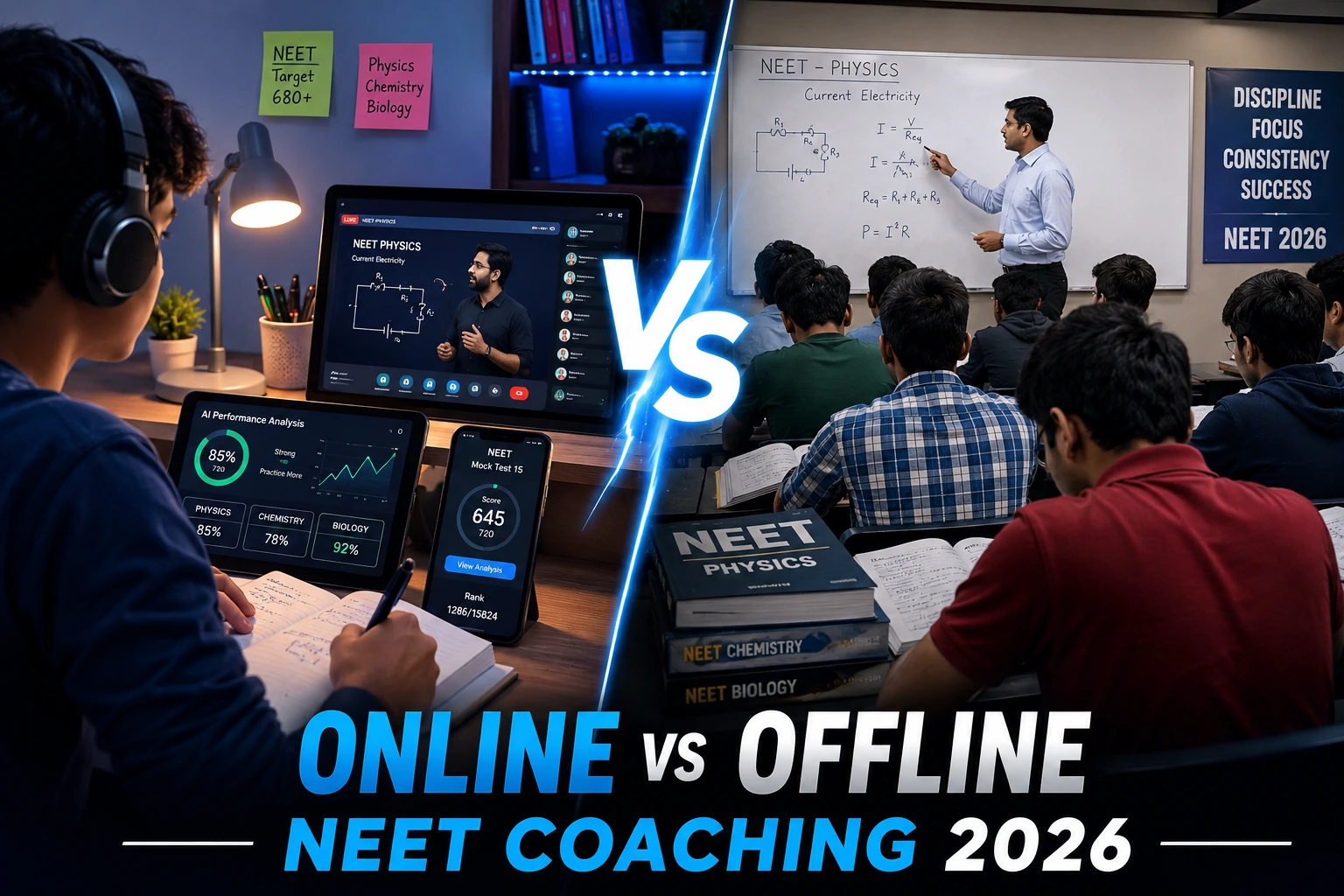
Every year, more than 2 million students appear for NEET, and the competition has never been tougher than it is in 2026. Whether you are a Class 11 student just starting out, a Class 12 student in the thick of preparation, or a dropper giving it another shot, one question keeps coming up: Should you go for online NEET coaching or stick with offline classroom coaching? The truth is, both modes have evolved significantly. Online platforms now offer AI-powered tracking and live faculty sessions, while offline institutes have started integrating digital tools into their curriculum. Choosing between them is no longer black and white. This guide breaks down everything, from fees and flexibility to doubt-solving and success rates, so you can make the right call based on your learning style and circumstances. What is Online NEET Coaching? Online NEET coaching refers to structured medical entrance preparation delivered through digital platforms. Students can attend live classes, watch recorded lectures, attempt mock tests, and interact with faculty, all from their homes using a smartphone or laptop. How Online NEET Classes Work Most online platforms operate through a combination of live sessions and pre-recorded content. Students join scheduled live classes via video conferencing, ask doubts in real time through chat or audio, and revisit recordings anytime. Mobile apps have made this even more accessible, allowing students in smaller towns and rural areas to access quality content without relocation. Features of Modern Online NEET Platforms • AI-based performance tracking that identifies weak topics and adjusts practice sets accordingly • Scheduled and on-demand doubt-solving sessions with subject experts • Comprehensive digital study material including PDFs, formula sheets, and revision notes • Flexible learning schedules that allow students to balance school and coaching • Online mock tests with detailed analytics and AIR (All India Rank) estimations Advantages of Online NEET Coaching • Study from any location without spending time or money on commuting • Significantly lower coaching fees compared to top offline institutes • Access to nationally recognized NEET faculty regardless of your city • Recorded sessions allow unlimited revision at your own pace • Ideal for students balancing Class 11 or 12 school attendance simultaneously Disadvantages of Online NEET Coaching • Home environments can be full of distractions that affect concentration • Requires a high level of self-discipline and personal accountability • Peer competition is minimal, which can reduce motivation for some students • Reliable internet connectivity is a prerequisite, which can be an issue in remote areas What is Offline NEET Coaching? Offline NEET coaching is the traditional classroom-based preparation model offered by institutes like Allen, Aakash, and Resonance. Students physically attend classes at a coaching center, follow a fixed timetable, and interact directly with teachers and peers. Traditional Classroom Learning Explained In a conventional offline setup, students attend face-to-face lectures in batches, write physical notes, and appear for regular tests conducted on-site. Daily attendance creates a rhythm and sense of accountability that many students find helpful. The structured environment mimics exam conditions and trains students to perform under pressure. Features of Offline NEET Coaching Institutes • Regularly scheduled classroom tests and weekly assessments • Physical doubt counters where students can sit and get one-on-one faculty attention • Competitive classroom environment with peers working toward the same goal • Fixed timetable that enforces a disciplined daily study routine Advantages of Offline NEET Coaching • Structured environment naturally reduces distractions and improves focus • Direct, real-time interaction with teachers builds concept clarity faster • Healthy peer competition motivates students to push their limits • Fixed schedule removes decision fatigue about when and what to study Disadvantages of Offline NEET Coaching • Coaching fees at premium institutes can range from Rs. 1.5 to 3 lakh per year • Daily commuting consumes time that could otherwise be used for self-study • Rigid batch schedules offer no room for personal learning pace adjustments • Relocation to coaching hubs like Kota or Delhi may add hostel and living costs Online NEET Coaching vs Offline Coaching – Detailed Comparison Here is a side-by-side breakdown across the factors that matter most to NEET aspirants: Factor Online Coaching Offline Coaching Verdict Fees Low to Moderate High Online wins Flexibility High Low Online wins Discipline Self-driven Structured Offline wins Doubt Solving Chat/Video sessions Face-to-face Offline wins Faculty Access Top national faculty Local faculty Online wins Study Material Digital + PDFs Printed books Tie Mock Tests AI-powered online Physical tests Online wins Peer Competition Limited Strong Offline wins Teaching Quality Comparison Online platforms often bring together the best subject teachers from across India into a single course. A student in a small town in Uttarakhand can now learn Biology from a Kota-based expert and Physics from a Delhi-based specialist. Offline institutes, while having strong faculty, are geographically limited. Fees Comparison Online NEET coaching typically costs between Rs. 15,000 and Rs. 60,000 per year depending on the platform and plan. Offline coaching at premium institutes can go up to Rs. 3 lakh annually, excluding hostel and travel. For students from middle-income families, this gap is a decisive factor. Flexibility and Time Management Online coaching offers complete control over your daily schedule. Recorded lectures mean you can study at 10 PM if that is when you are most alert. Offline coaching runs on fixed batch timings, which may clash with school hours for Class 11 and 12 students. Doubt Solving Support This is where offline coaching traditionally had an edge. Being able to walk up to a teacher after class is faster and more personal. Online platforms have narrowed this gap with live doubt sessions, WhatsApp support groups, and AI-powered Q&A bots, but some students still prefer the immediacy of in-person help. Success Rate Comparison in 2026 Both modes produce NEET qualifiers and toppers. What separates successful students from unsuccessful ones is rarely the coaching mode itself. Consistency, NCERT mastery, and regular mock test practice are the real differentiators. That said, online platforms have shown improving placement statistics as their test series and content quality have matured significantly since 2022. Which Students Should Choose Online NEET Coaching? Best for Self-Disciplined Students If you already have strong study habits, can stick to a self-made schedule, and do not need external pressure to open your books, online coaching gives you the flexibility and quality you need without the overhead costs. Best for Rural Area Students Students in towns and villages without access to quality offline institutes can now compete on equal footing. Online coaching removes geography as a barrier to quality NEET preparation. Best for Budget-Friendly Preparation If your family cannot afford the full fees and relocation expenses of a top offline institute, online coaching from platforms like Physics Wallah or Unacademy offers surprisingly strong preparation at a fraction of the cost. Best for School and NEET Balance Class 11 and 12 students who cannot afford to skip school will find online coaching far more compatible with their daily routine. Recorded lectures and weekend-heavy live sessions make simultaneous preparation manageable. Which Students Should Choose Offline NEET Coaching? Students Who Need Personal Guidance If you frequently need in-depth explanations, prefer face-to-face interaction with faculty, and benefit from mentors who know you by name and can track your individual progress, offline coaching is the better fit. Students Who Get Distracted Easily If your home environment is noisy, filled with family responsibilities, or simply not conducive to focused study, the structured isolation of a coaching center can be genuinely transformative. Students Who Prefer Classroom Competition Regular batch tests, leaderboards, and peer comparison are powerful motivators. If seeing your classmates score higher pushes you to work harder, the offline classroom environment works in your favor. Students Needing a Strict Study Routine For students who struggle with procrastination and cannot self-regulate their study hours, a fixed daily schedule at an offline institute removes the choice, and sometimes, removing the choice is exactly what is needed. Hybrid NEET Coaching – The New Trend in 2026 What is Hybrid Learning? Hybrid NEET coaching combines the best of both worlds. Students attend either live online classes or local offline classes for core subject teaching, while supplementing with online mock tests, recorded revision lectures, and digital study material. This model has been growing rapidly since 2024. Benefits of Combining Online and Offline Preparation • Core concept understanding from structured offline sessions or live online classes • Unlimited revision through recorded online lectures • All-India level mock test benchmarking through online platforms • Lower overall cost compared to full-time offline enrollment • Greater flexibility for school-going students Is Hybrid Coaching Better for NEET Aspirants? For most students, especially droppers and those targeting AIR under 10,000, hybrid preparation is increasingly becoming the preferred approach. Joining a local offline test series while using an online platform for daily learning gives students structured accountability without sacrificing flexibility or quality. Best Online NEET Coaching Platforms in 2026 Popular Online NEET Learning Apps • Physics Wallah (PW) – Known for affordable pricing and strong Physics and Chemistry faculty. Offers live batches, recorded courses, and an active doubt community. • Unacademy – Wide faculty pool, structured live classes, and detailed performance analytics. NEET-specific batches are well-organized. • Aakash BYJU'S – Combines Aakash's decades of NEET expertise with BYJU'S digital infrastructure. Offers both online and hybrid options. • Allen Career Institute (Online) – Allen's brand reputation now extends to its digital platform with live classes and their well-regarded test series available online. Features to Check Before Joining Any Coaching • Quality and experience of Biology, Physics, and Chemistry faculty • Availability and quality of NEET-specific mock test series • Doubt-solving response time and accessibility • Access to recorded lectures for revision • Student reviews and recent NEET qualifier testimonials Tips to Crack NEET 2026 Regardless of Coaching Mode Consistency Matters Most Whether you are studying online or offline, showing up every single day matters more than any single brilliant study session. NEET rewards steady effort over time, not last-minute cramming. Mock Tests and Revision Strategy Begin attempting full-length NEET mock tests from Month 3 of your preparation. Analyze every wrong answer, understand the error type, whether it is a conceptual gap, a silly mistake, or a time management issue, and fix it before the next test. NCERT-Based Preparation NEET, especially Biology, is still firmly rooted in NCERT textbooks. Every line of the Biology NCERT is fair game. Read it multiple times, make notes, and do not skip diagrams. For Physics and Chemistry, use coaching material for problem practice but always trace concepts back to NCERT. Time Management Tips • Divide daily study time across all three subjects without neglecting any one • Allocate more time to your weakest subject while maintaining the other two • Keep one day per week purely for revision and mock test analysis • Sleep for at least 7 hours. Cognitive performance directly impacts exam scores Daily Study Discipline Set a fixed start and end time for your study day. Treat your study schedule like school hours. Use the Pomodoro technique (50 minutes study, 10 minutes break) to maintain focus, especially during long self-study sessions. Final Verdict – Online or Offline Coaching for NEET 2026? There is no single winner in the online vs offline debate because the better option depends entirely on who you are as a student. If you are self-motivated, live in a smaller town, or are working with a limited budget, online NEET coaching from a reputed platform is not just adequate. It is genuinely excellent. The gap in teaching quality between top online platforms and offline institutes has narrowed dramatically. If you struggle with distractions, need peer motivation, or require face-to-face faculty interaction to build concept clarity, offline coaching offers a structure that can be hard to replicate at home. For many NEET aspirants in 2026, the smartest move is to stop thinking in binary terms. Use online platforms for daily learning, recorded revision, and mock tests. Use offline resources for periodic doubt clearing, test series, and accountability. This hybrid approach is what a growing number of NEET toppers are already doing. Whichever mode you choose, remember that the coaching is only the vehicle. The determination you bring every day is the engine. NEET has been cracked by students from small villages using phone data and free YouTube resources, and it has been failed by students with access to every premium resource available. The difference was never the coaching mode. It was the consistency, honesty with oneself, and willingness to keep going. You have everything you need. Now go use it. Frequently Asked Questions FAQ 1: Is online coaching enough for NEET 2026 preparation? Online NEET coaching can be fully sufficient for students who maintain strong discipline, follow a structured study plan, and regularly practice NCERT content along with mock tests. Many NEET qualifiers in recent years have relied entirely on online platforms. FAQ 2: Which is better for NEET preparation – online or offline coaching? Both are effective when used correctly. Online coaching offers flexibility and affordability, making it ideal for self-disciplined students. Offline coaching provides structured discipline and direct teacher interaction, making it better for students who need an external push. FAQ 3: Can I crack NEET with online coaching only? Yes. Thousands of students crack NEET every year through online-only preparation. The key ingredients are consistency, thorough NCERT revision, and regular full-length mock test practice with detailed error analysis. FAQ 4: What are the disadvantages of online NEET coaching? The primary challenges include potential distractions at home, the need for strong self-discipline, reduced peer competition, and dependence on reliable internet access. Students who struggle with self-motivation often find the offline environment more productive. FAQ 5: Is offline coaching necessary for NEET aspirants? No, offline coaching is not compulsory. Students with solid self-study habits and access to quality online platforms can achieve high NEET scores without ever stepping into a coaching center. What matters is the quality of preparation, not the location. FAQ 6: What is the best coaching method for NEET droppers in 2026? Hybrid learning is proving to be the most effective strategy for NEET droppers in 2026. Merging the organized approach of offline test series with the adaptability and in-depth content of online platforms enables droppers to achieve both consistency and quality without incurring the full expense. of offline enrollment.
Read More →Subscribe to our newsletter for the latest articles, study tips, and exam preparation strategies delivered to your inbox.