
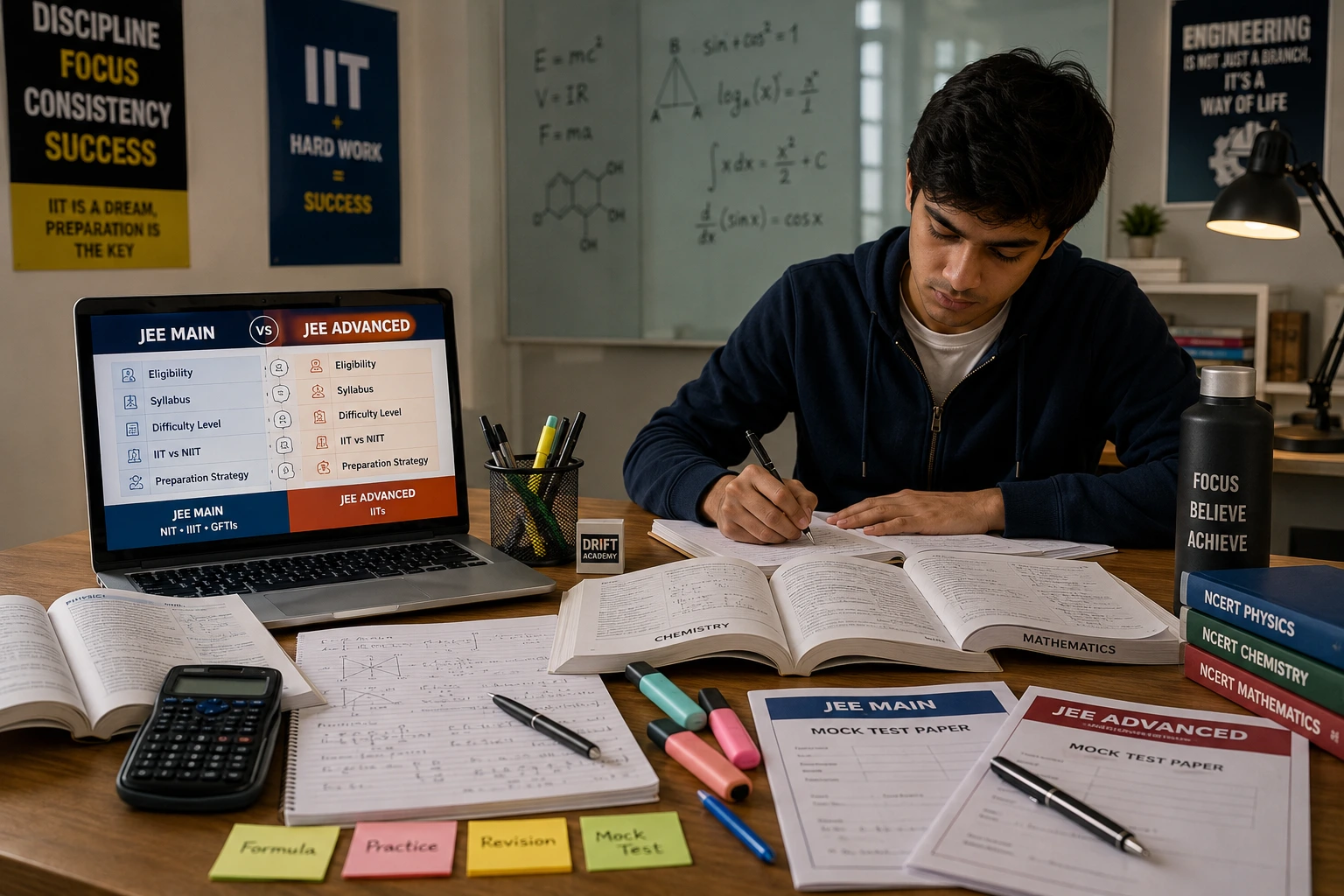
JEE Main versus JEE Advanced: Full Comparison, Requirements, Curriculum & Study Guide (2026)
Every year, over 12 lakh students register for the IIT JEE examination cycle with one common goal: securing a seat in India's premier engineering institutions. But many aspirants, especially those just starting out, find themselves confused between two exams that share a name yet differ dramatically in scope, difficulty, and purpose.
JEE Main and JEE Advanced are not interchangeable. They are two distinct stages of a single admission process. Understanding how they differ is not just useful — it is the foundation of any smart IIT or NIT preparation strategy.
This guide gives you an honest, side-by-side breakdown of both exams covering eligibility, syllabus, difficulty, exam pattern, and the most effective preparation approach for 2026 aspirants.
What is JEE Main?
Overview of JEE Main
JEE Main is the first-stage national engineering entrance examination conducted by the National Testing Agency (NTA). It serves as the qualifying gateway for admission to National Institutes of Technology (NITs), Indian Institutes of Information Technology (IIITs), and Government Funded Technical Institutions (GFTIs) across India.
Beyond these institutions, JEE Main also acts as the qualifying round for JEE Advanced In simple terms, without a strong JEE Main performance, the door to IITs remains closed.
Key Features of JEE Main
• Conducted twice a year — typically in January and April
• Fully computer-based test (CBT) with multiple-choice and numerical answer-type questions
• Covers Physics, Chemistry, and Mathematics from Class 11 and 12 NCERT syllabi
• Students can appear up to 6 times across 3 consecutive years after Class 12
• The highest score from all attempts is taken into account for ranking.
• Paper 1 is for B.Tech admissions; Paper 2 is for B.Arch and B.Planning
JEE Main Difficulty Level
JEE Main is at a medium level of difficulty. A student who has thoroughly studied NCERT textbooks and practiced previous year papers can build a strong foundation for this exam. The emphasis is on speed and accuracy — the ability to solve familiar question types quickly under time pressure. Most toppers describe it as a test of preparation breadth rather than exceptional conceptual depth.
What is JEE Advanced?
Overview of JEE Advanced
JEE Advanced represents the second and last step in the IIT admission procedure.It is conducted by one of the seven zonal IITs on a rotational basis and is the sole entry point for undergraduate admissions to all 23 IITs in India.
Only the top 2.5 lakh candidates from JEE Main (based on All India Rank) are eligible to appear. This automatic shortlisting makes JEE Advanced inherently more competitive from the first step.
Key Features of JEE Advanced
• Two mandatory papers (Paper 1 and Paper 2), both conducted on the same day
• Questions include single correct, multiple correct, integer type, and matching-list formats
• No fixed syllabus document — the paper pattern and question types can vary each year
• Negative marking applies, but rules differ across question types
• Maximum of 2 attempts allowed in 2 consecutive years
• Students who have previously accepted a seat at an IIT through JESAa counselling cannot re-appear
JEE Advanced Difficulty Level
JEE Advanced is widely considered one of the toughest undergraduate entrance exams in the world. Unlike JEE Main, it does not test how quickly you can recall formulas — it tests how deeply you understand concepts and whether you can apply them to unfamiliar, multi-layered problems. Questions often combine two or three topics in a single problem, requiring analytical thinking rather than textbook answers.
JEE Main vs JEE Advanced — Major Differences at a Glance
The table below summarizes the core differences between both exams across the most critical parameters
Factor JEE Main JEE Advanced
Conducting Body NTA (National Testing Agency) IITs (on rotation every year)
Primary Purpose Admission to NITs, IIITs & GFTIs Admission to IITs exclusively
Difficulty Level Moderate — NCERT-focused Very High — application & analysis based
Who Can Appear Class 12 PCM students Top 2.5 lakh JEE Main qualifiers only
Question Pattern Largely predictable & structured Dynamic, unpredictable, multi-format
Number of Papers Paper 1 (B.Tech) & Paper 2 (B.Arch) 2 mandatory papers (Paper 1 & 2)
Exam Mode Fully computer-based (CBT) Computer-based (CBT)
Key Focus Area Speed, accuracy & formula recall Deep conceptual clarity & reasoning
Attempts Allowed 2 per year, up to 3 years Maximum 2 attempts in consecutive years
Score Used For NIT/IIIT rank via JEE Main score IIT rank via JEE Advanced marks
JEE Main vs JEE Advanced Syllabus Comparison
Common Subjects Across Both Exams
Both exams test the same three subjects: Physics, Chemistry, and Mathematics. The Class 11 and 12 NCERT curriculum forms the backbone for both. However, the depth and style of questions differ considerably.
How the Syllabus Actually Differs
JEE Main is tightly aligned with the NCERT syllabus. If you know your textbooks inside out and can solve standard problems accurately, you stand a strong chance. JEE Advanced, on the other hand, takes the same topics and demands a far deeper level of understanding. It expects you to derive, connect, and apply concepts in ways that go beyond textbook exercises.
For example, a JEE Main question on projectile motion might ask you to find the range given standard values. A JEE Advanced question on the same topic could introduce a variable force, an irregular surface, and require you to integrate across multiple physical concepts to arrive at the answer.
High-Weightage Topics for Both Exams
Certain topics carry significant weight in both exams and deserve priority attention
• Physics: Mechanics, Electrostatics, Modern Physics, Optics, Waves
• Chemistry: Organic Reaction Mechanisms, Coordination Compounds, Electrochemistry, Chemical Bonding
• Mathematics: Calculus (Differential & Integral), Coordinate Geometry, Probability, Vectors & 3D
Eligibility Criteria for JEE Main and JEE Advanced 2026
JEE Main Eligibility
To appear for JEE Main 2026, a candidate must satisfy the following conditions
• Must have completed or be currently enrolled in Class 12 (or equivalent) with Physics, Chemistry, and Mathematics as main subjects.
• No upper age limit (as of recent NTA guidelines, though candidates should verify for the latest update)
• Can attempt JEE Main up to 3 consecutive years from the year of Class 12 qualification
• Students who passed Class 12 in 2024 or 2025 are also eligible for the 2026 cycle
JEE Advanced Eligibility
JEE Advanced has stricter criteria that filter candidates even further
• Must rank within the top 2.5 lakh in JEE Main 2026 (across all categories)
• Should not have previously taken admission at an IIT (even after paying seat confirmation fees)
• Can appear for JEE Advanced at most twice in two consecutive years
• Should have appeared in Class 12 for the first time in 2025 or 2026
• Must meet the minimum percentage requirement in Class 12 as stipulated by the respective IIT
Which is more challenging — JEE Main or JEE Advanced?
The Honest Difficulty Comparison
There is no debate here among serious aspirants: JEE Advanced is significantly harder than JEE Main. But what exactly makes it harder is worth understanding.
JEE Main tests whether you know the right formula and can apply it accurately in a time-bound setting. JEE Advanced tests whether you understand why the formula works — and what happens when the standard conditions no longer apply. This shift from knowledge-based to understanding-based testing is what trips up many students who perform brilliantly in JEE Main but struggle in JEE Advanced.
Competition and Selection Ratio
In 2025, over 13 lakh students appeared for JEE Main. Of these, approximately 2.5 lakh were shortlisted for JEE Advanced. Out of those shortlisted, only around 17,000 students secured ranks good enough for IIT admission. That is a final selection rate of roughly 1.3% of all JEE Main registrants — making the combined process one of the most competitive in the world.
Analytical Thinking Is the Differentiator
Students who make it to IITs consistently report that the key to clearing JEE Advanced was not studying more topics — it was studying each topic at a much deeper level. Understanding derivations, exploring edge cases, and working through problems that do not resemble any standard textbook question are the habits that separate JEE Advanced qualifiers from the rest.
Can You Prepare for JEE Main and Advanced Together?
Smart Joint Preparation Strategy
Yes, and in fact this is the recommended approach. Preparing separately for each exam is inefficient. If you build your preparation with JEE Advanced as the benchmark, JEE Main becomes a natural byproduct of that effort.
The logic is simple: JEE Advanced demands deeper understanding. JEE Main demands accuracy and speed. If your foundation is strong enough for Advanced, performing well in Main only requires adding speed practice through regular mock tests.
A Practical Study Framework
• Start with NCERT: Clear every concept from Class 11 and 12 textbooks before touching any advanced material
• Layer advanced resources: Move to HC Verma (Physics), OP Tandon (Chemistry), and Cengage or Arihant series (Mathematics) after NCERT is solid
• Solve PYQs: Previous year papers for both JEE Main and Advanced are irreplaceable tools for understanding question patterns
• Mock tests weekly: Full-length timed tests build exam temperament and expose gaps in your preparation
• Analyze every test: Reviewing what went wrong in a mock is more valuable than taking the next one without reflection
• Revision cycles: Rotate through all subjects every 2 to 3 weeks to prevent forgetting earlier topics
Common Mistakes to Avoid
• Skipping NCERT and jumping to advanced resources too early
• Focusing only on JEE Main-level practice when the target is IIT
• Not maintaining an error log — repeating the same mistakes in different tests
• Neglecting Chemistry, which is actually the most scoring subject per minute of effort
• Under-practicing integer-type and multi-correct questions that are specific to JEE Advanced
Subject-Wise Preparation Tips
Physics
Start with Mechanics and ensure your understanding of Newton's laws, energy, and rotational motion is rock solid — these topics appear in virtually every JEE Advanced paper. For JEE Main, focus on formula accuracy and unit consistency. For Advanced, practice problems where multiple physical systems interact simultaneously.
Chemistry
Chemistry rewards consistent revision over brute-force problem solving. Organic Chemistry, particularly named reactions and mechanisms, needs to be internalized rather than memorized. Physical Chemistry requires solid Mathematics integration. Inorganic Chemistry is almost entirely NCERT-based for JEE Main, but JEE Advanced can test subtle exceptions and periodic trends in unexpected ways.
Mathematics
Calculus is the backbone of JEE Mathematics at both levels. Differential equations, integration techniques, and application-based calculus problems form a large portion of marks in both exams. Coordinate Geometry and Probability are reliable score-boosters in JEE Main. For Advanced, emphasize proof-oriented reasoning in Algebra and 3D Geometry.
Why Structured Coaching Matters for IIT-JEE Preparation
Self-study is powerful, but it has a fundamental limitation: you do not know what you do not know. A structured coaching program provides external pressure through regular testing, exposes blind spots through mentorship, and gives access to curated study material refined over years of examination analysis.
For students in Aligarh and surrounding areas, Drift Academy offers a focused JEE preparation program built around the actual demands of both JEE Main and Advanced. The faculty brings classroom teaching in line with IIT-level thinking — not just formula drilling — and the mock test system is designed to replicate the psychological demands of exam day.
Whether you are a Class 11 student just starting your journey or a Class 12 student heading into the final lap, structured preparation with regular accountability checkpoints makes a measurable difference in outcomes.
Final Verdict — JEE Main vs JEE Advanced
JEE Main and JEE Advanced are not competing exams — they are consecutive chapters in the same story. JEE Main opens the door to excellent NITs and IIITs while also being the qualifier for the next stage. JEE Advanced is the final filter for the most competitive engineering seats in the country.
The students who succeed at both share one trait: they never prepared at the level of the exam — they prepared above it. Treat JEE Advanced as your standard, use JEE Main as a confidence checkpoint, and build a preparation system that makes conceptual depth your default rather than your exception.
The IIT dream is demanding, but it is not unreachable. With the right strategy, honest self-assessment, and consistent effort over time, both JEE Main rank and IIT admission are achievable goals.
FAQs — JEE Main vs JEE Advanced
1 What is the key distinction between JEE Main and JEE Advanced?
JEE Main is the national-level entrance exam for admission to NITs, IIITs, and GFTIs, conducted by NTA. JEE Advanced is conducted by the IITs and is the only route to IIT undergraduate admissions. You must qualify JEE Main before you are eligible to appear for JEE Advanced.
2. Is JEE Advanced significantly harder than JEE Main?
Yes. JEE Advanced demands a much deeper conceptual understanding and tests analytical thinking through application-based, multi-layered problems. JEE Main primarily focuses on speed, formula application, and NCERT-level understanding.
3. Can I appear for JEE Advanced without qualifying JEE Main?
No. JEE Main qualification is a mandatory prerequisite. Only candidates who rank within the top 2.5 lakh in JEE Main are shortlisted for JEE Advanced.
4. Which syllabus is more challenging — JEE Main or JEE Advanced?
Both cover similar topics, but JEE Advanced requires a far deeper level of understanding and application. JEE Main is more closely aligned with the NCERT curriculum, while JEE Advanced goes well beyond standard textbook problems.
5. Can I prepare for JEE Main and JEE Advanced at the same time?
Absolutely. Preparing with JEE Advanced as the benchmark automatically ensures strong performance in JEE Main. Use NCERT as the foundation, then build advanced conceptual clarity alongside regular speed practice through mock tests.
6. Which is the best coaching institute for JEE in Aligarh?
Students in Aligarh looking for structured IIT-JEE preparation, experienced mentorship, and a mock test program designed for both JEE Main and Advanced can consider Drift Academy for a focused and result-oriented coaching experience.