

Discover the techniques our top performers use to excel. Cut through the noise and focus on what matters most for your exam preparation.
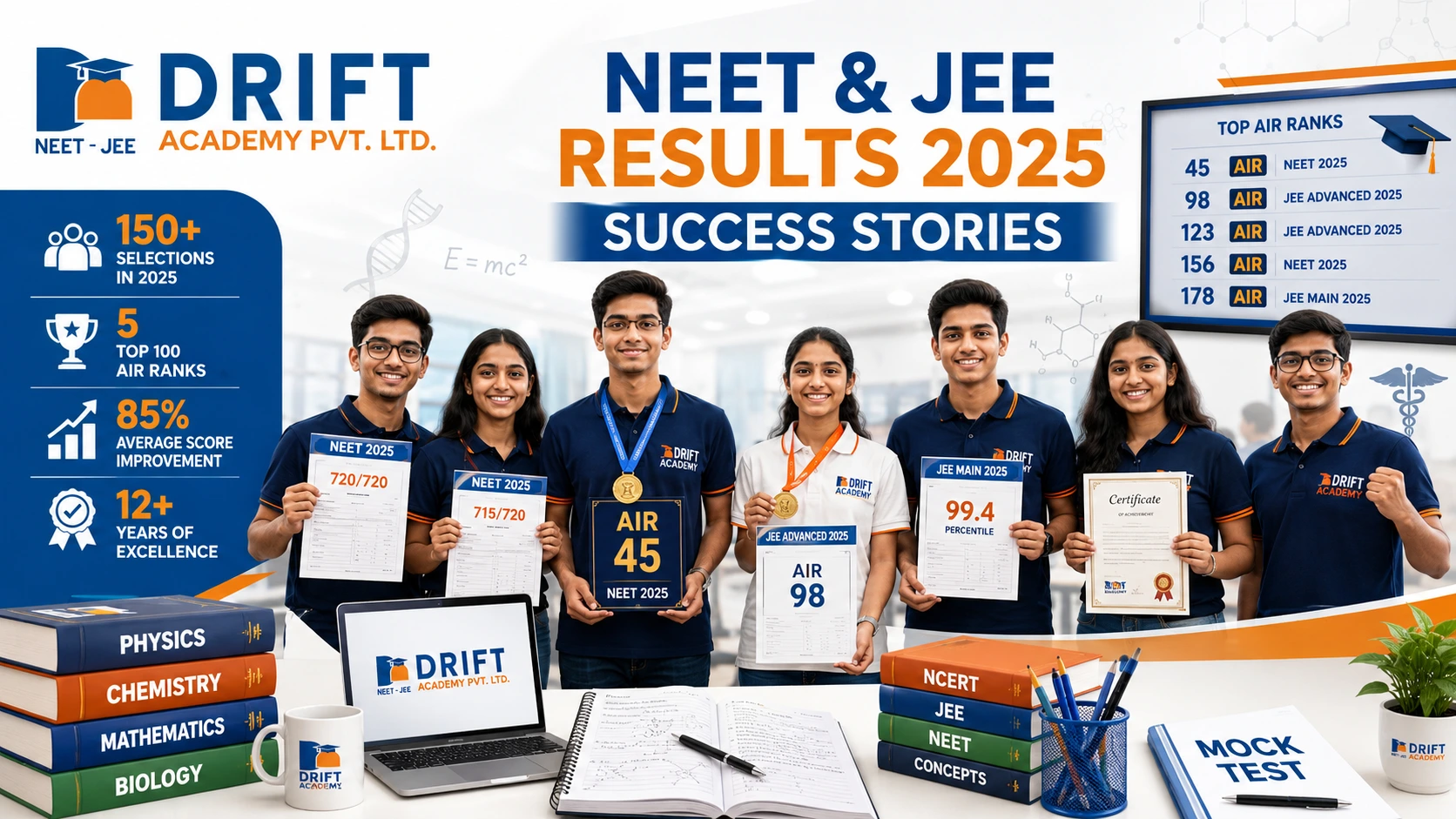
Drift Academy Student Results 2025 NEET & JEE Success Stories Every year, millions of students appear for the NEET and JEE two incredibly difficult and competitive exams. The pressure is enormous, the syllabus vast, and the difference between success and failure is minimal. Choosing the right coaching institute becomes crucial. Drift Academy, Aligarh, Uttar Pradesh, saw a landmark year in 2025 150+ confirmed NEET selections, 5 students securing top 100 All India Ranks (AIR) in NEET, 200+ selections and 8 students securing top 500 AIR in JEE, and 85% average score improvement among enrolled students. These are not just numbers they are proof of a proven methodology. Why go to Drift Academy in Aligarh for NEET & JEE Results Aligarh has become a major hub for competitive exam preparation in northern India. There are many institutes here, but Drift Academy has distinguished itself not just through marketing promises, but through measurable academic outcomes. Proven Track Record of 15+ Years With over 15 years of experience, Drift Academy has built a reliable legacy in coaching for medical and engineering entrance exams. The institute's approach has always prioritized genuine learning and the 2025 results are a direct reflection of this philosophy. Expert Faculty & Personalized Mentorship Drift Academy's faculty consists of subject experts who bring both academic depth and real-world exam experience to the classroom. Each student receives one-on-one mentorship sessions to identify weaknesses early and build individual strengths. Only 30 Students Per Batch Full Attention to Every Student Drift Academy consciously limits batch sizes to just 30 students. This ensures that every student gets the attention they deserve and no question goes unanswered. Regular Mock Tests & Performance Analysis A major pillar of Drift Academy's success strategy is its robust test series. Students take regular mock tests modeled on actual NEET and JEE patterns. Post-test analysis sessions help them understand where they went wrong and how to avoid making the same mistakes in the final exam. Drift Academy NEET Results 2025 – Medical Aspirants Make History The NEET 2025 results have been a defining moment for Drift Academy. The numbers speak clearly, but the stories behind these numbers are even more powerful. 150+ NEET Selections in 2025 Over 150 students successfully qualified for NEET UG 2025 from Drift Academy an achievement that firmly places the institute among the top-performing coaching centers in the region. This is the result of coordinated hard work by students, faculty, and the academic planning team throughout the year. 5 Students Among Top 100 All India Rankings Five students from Drift Academy made it to the top 100 All India Ranks in NEET 2025 a distinction achieved by very few institutes in Uttar Pradesh. These toppers attributed their success to structured daily study plans and faculty guidance that kept them focused and exam-ready throughout the year. Our NEET Star Performers of 2025 Some of our standout NEET 2025 qualifiers whose hard work and dedication made a dream come true for them and their families: Arisha Tasneem: NEET 2025 Topper (Top 2 Rank at Drift Academy) Altamash Khan: Exceptional performer, Top 4 Rank at Drift Academy Akbar Usmani: Top 5 Rank at Drift Academy Kratika: Consistent performer, Top 8 Rank at Drift Academy Haniya Younus: Top 9 Rank at Drift Academy Liyba Naseem: Top 12 Rank at Drift Academy Azkiya Hussain: Top 18 Rank at Drift Academy Afreen Urooj: Top 19 Rank at Drift Academy Arisha Tasneem herself has shared her preparation strategy – her entire success story can be seen on the Drift Academy YouTube channel and is an inspiration for future students. 85% Average Score Improvement The most telling metric for 2025 was an 85% average score improvement among students. Even students who came in with modest diagnostic scores and had previously failed to clear NEET saw dramatic improvements this clearly indicates that the institute's preparation model works at every ability level. Drift Academy JEE Results 2025 – Engineering Dreams Haqeekat Bane The JEE journey demands a unique kind of preparation one that balances speed with accuracy and conceptual depth with problem-solving agility. Drift Academy's JEE division delivered impressive results in both JEE Main and JEE Advanced in 2025. 200+ JEE Selections 8 Students in Top 500 AIR More than 200 students secured selection in JEE Advanced & Mains and 8 students made it to the top 500 All India Rank. Many students achieved JEE Main scores above 95 percentile. The Institute's emphasis was on formula mastery, speed drills, and chapter-wise test series, which pushed students beyond the qualifying threshold. IIT & NIT Admissions Multiple Drift Academy alumni secure admissions to IITs and NITs in 2025 the engineering dreams they dreamt of when they enrolled at Drift Academy many years ago have become reality today. JEE Students Ki Daily Preparation Strategy Drift Academy's JEE students follow a carefully designed schedule: concept learning in the morning, application-based practice in the afternoon, and error analysis in the evening. This three-phase daily structure, along with bi-weekly full-length mock tests, ensured consistent progression in Physics, Chemistry, and Mathematics tenon subjects. Student Success Stories That Inspire Future Aspirants From Average Student to Top Ranker Not all success stories start with brilliant scores. Some of the most inspiring outcomes from Drift Academy's 2025 batch came from students who ranked lowest in their diagnostic test rankings. Targeted coaching, regular feedback, and sheer determination helped these students secure competitive ranks in the NEET and JEE. Consistent Practice Ne Scores Badlaye Data from Drift Academy's internal tracking system consistently shows that students who completed more than 90% of assigned practice modules performed better regardless of the starting point. Consistency turned out to be a stronger predictor of final success than raw ability. Role of Mock Tests & Doubt Sessions Structured doubt-clearing sessions three times a week allowed students to resolve conceptual gaps in real time. Combined with post-mock analysis, these sessions accelerated learning cycles and helped students adapt their exam strategies before the actual test date. ..... Key aspects of Drift Academy's 2025 results presentation NCERT-Focused Study Material Both NEET and JEE place a heavy emphasis on NCERT-level understanding, especially in Chemistry and Biology. Drift Academy's study material is built around NCERT concepts ensuring a strong foundation before moving on to advanced problem sets. Daily Practice & Comprehensive Test Series Daily practice papers, subject-wise sectional tests, and full-length mock exams form the backbone of Drift Academy's academic calendar. This test-heavy environment conditions students to perform under pressure a skill that directly translates into exam-day confidence. One-to-One Mentorship Programs At Drift Academy, each student is assigned a dedicated mentor who tracks their academic progress on a weekly basis. This personalized oversight catches performance dips early, addresses motivational challenges, and keeps students aligned with their preparation goals. Time Management & Exam Strategy Training A major focus area at Drift Academy is teaching students to manage time efficiently during exams. Students are taught to identify high-value questions, strategically skip difficult ones and return, and maintain accuracy without sacrificing speed. Drift Academy Mein NEET vs JEE Preparation Strategy Different Study Plans for Medical & Engineering Aspirants Drift Academy doesn't follow a one-size-fits-all model. NEET aspirants follow a Biology-heavy curriculum with an equal focus on Physics and Chemistry, while JEE aspirants take Physics and Chemistry along with an intensive Mathematics program. Both tracks have separate faculties and customized timetables. Smart Preparation Techniques Students are trained in high-yield preparation strategies such as spaced repetition for memory retention, active recall instead of passive reading, and topic prioritization based on previous years' question patterns. These techniques maximize the output of every hour of study. Structured Revision & Doubt-Clearing System Drift Academy operates a three-phase revision system: chapter-end revision after each unit, a mid-year comprehensive review, and a pre-exam final revision sprint months before exams. Doubt sessions are scheduled after each phase to consolidate learning. Stress Management During Preparation This level of exam preparation can take a mental toll. Drift Academy incorporates regular counseling check-ins and motivational sessions into its academic program. Students are encouraged to take structured breaks, maintain healthy routines, and develop a positive relationship with the preparation process. How to Join Drift Academy for NEET & JEE 2026 Preparation Admission Process Admissions at Drift Academy are conducted through a diagnostic entrance test that helps the institute place students in the appropriate batch based on their current level. Interested candidates can visit driftacademy.in or directly contact the admissions team to schedule their test. Scholarship Opportunities Drift Academy offers merit-based scholarships for students who demonstrate strong performance on diagnostic tests or board exams. Scholarships help deserving students access quality coaching without a financial burden. Classroom & Online Coaching Options For students who cannot relocate to Aligarh, Drift Academy offers online coaching programs that mirror the classroom experience as closely as possible. Live sessions, recorded lectures, online test series, and virtual doubt-clearing ensure that geographical distance does not compromise preparation quality. Conclusion Drift Academy's 2025 results are a compelling statement about focused, personalized, and result-oriented coaching. With 150+ NEET selections, 5 Top 100 AIR holders including Arisha Tasneem, Altamash Khan, Akbar Usmani, Kratika, Haniya Younus, Liayba Naseem, Azkiya Hussain and Afreen Urooj, 200+ selections in JEE and 8 Top 500 AIR holders, IIT and NIT admits, and 85% average score improvement the institute has cemented its place as one of the most trusted competitive exam coaching names in Aligarh. If you're preparing for NEET or JEE in 2026, the time to act is now. The difference between where you are and where you want to be is often a structured preparation plan and the right guidance. Drift Academy has both. Visit driftacademy.in today – book your free counselling session and take the first step towards your medical or engineering career. Frequently Asked Questions (FAQs) Q1: What are the NEET 2025 Results of Drift Academy? Drift Academy has achieved 150+ confirmed NEET selections in 2025. 5 students made it to the Top 100 All India Ranks, including Arisha Tasneem, Altamash Khan, Akbar Usmani, Kratika, Haniya Younus, Liayba Naseem, Azkiya Hussain, and Afreen Urooj. The student body recorded an 85% average score improvement compared to their initial diagnostic performance. Q2: Is Drift Academy Aligarh good for JEE preparation? Yes. Drift Academy is consistently considered one of the best JEE coaching institutes in Aligarh. Its experienced faculty, structured test series, and proven track record of JEE Main and Advanced qualifiers make it a preferred choice for engineering aspirants in the region. Q3: How does Drift Academy help students improve their NEET scores? The Institute combines NCERT-focused study material, personalized mentoring, regular mock tests with detailed analysis, and structured doubt-clearing sessions. This multi-layered approach helps students systematically identify and fix weak areas, leading to measurable score improvements. Q4: Does the policy of only 30 students per batch make any difference? Absolutely. Drift Academy has a maximum of 30 students per batch this means faculty have time to track each student's progress, doubts never go unaddressed, and mentorship is genuinely personalized. This is what makes it fundamentally different from large-scale coaching factories. Q5: Can average students crack NEET or JEE with Drift Academy's coaching? Absolutely. Drift Academy's 2025 success stories include many students who began their preparation from average performance levels and the results of Kratika, Azkiya Hussain, Liayba Naseem, and others prove it. Steady effort, mentorship from faculty, and the organized academic framework of the institute enabled these students to enhance their performance and secure qualifying positions in both NEET and JEE. Q6: How to get admission in Drift Academy? Admissions are through a diagnostic entrance test. Interested candidates can visit driftacademy.in or call +91 7300666551. Free counseling sessions are also available for first-time inquiries.
Read More →
# Best JEE Preparation Structure Most JEE aspirants study 10 to 12 hours daily yet only a fraction clear the exam with a competitive rank. The reason is rarely a lack of effort. It is almost always the absence of a proven study framework that brings together concept building, revision cycles, mock test analysis, and consistent performance tracking under one system. IIT admissions go to students who follow a smart, structured learning system that compounds their effort over time. This guide breaks down exactly what that structure looks like across every stage of preparation and explains how Drift Academy's JEE success framework supports aspirants throughout their IIT journey. ## Why a Structured JEE Preparation Roadmap Matters for IIT Aspirants ### The Difference Between Random Studying and a JEE Preparation Framework Random studying feels productive: open a chapter, solve problems, watch lectures, repeat. But without a clear JEE preparation framework, there is no direction. Topics get revisited out of order. High-weightage chapters get skipped. Weak areas go unaddressed for weeks. A JEE preparation roadmap maps the entire NTA syllabus across a timeline. Every week has defined targets. Every month builds on the last. Students know where they stand and what needs attention next. ### Common Mistakes Students Make During IIT JEE Preparation The three most costly mistakes among IIT JEE aspirants are studying without a chapter-wise plan leading to uneven syllabus coverage, skipping mock tests until the final weeks, and ignoring revision cycles which causes even well-understood concepts to fade under exam pressure. Each of these is preventable with the right JEE preparation strategy from the start. ### Role of Performance Tracking and Goal-Based Learning Performance tracking separates aspirants who improve from those who plateau. Measuring accuracy, speed, and subject-wise percentile improvement over time reveals exactly where preparation is breaking down before it costs rank. Goal-based learning ties this data to weekly targets and monthly goals, creating a preparation timeline that is both ambitious and achievable. ## Essential Components of a High-Performance JEE Study Structure ### Concept Building Before Advanced Problem Solving Every JEE topper builds a strong conceptual base before moving to difficult problems. Attempting JEE Advanced-level questions without concept mastery leads to frustration and wrong approaches. Start with NCERT, understand derivations, then scale difficulty progressively. ### Chapter-Wise Planning for Physics, Chemistry, and Mathematics A high-performance JEE study structure requires chapter-wise planning for all three subjects. In Physics, Mechanics and Electrodynamics carry the most weight and should be covered early. In Chemistry, Physical Chemistry runs across both Main and Advanced and demands early attention. In Mathematics, Calculus, Coordinate Geometry, and Algebra are consistently high-yield areas. Planning chapter sequencing in advance prevents the panic of finding major topics untouched two months before the exam. ### Revision Cycles That Improve Long-Term Retention Without planned revision, topics studied thoroughly fade within weeks. The most effective JEE preparation strategy schedules revision cycles into the weekly routine, not as an afterthought before exams. Three to four spaced revision rounds over a few months dramatically improve retention and performance under actual exam conditions. ### Previous Year Questions and Their Importance in Exam Preparation Previous year JEE questions are among the most underused resources by aspirants. They reveal recurring question types, difficulty distribution across chapters, and the depth of conceptual clarity the exam demands. Solving them chapter by chapter and year by year sharpens exam readiness more than most other practice methods. ## JEE Preparation Structure by Stage ### Class 11 Students: Building the Foundation Class 11 is the single most important year in a JEE aspirant's preparation timeline. The concepts introduced here, especially in Mechanics, Algebra, and Physical Chemistry, form the foundation for everything in Class 12 and JEE Advanced. Rushing through them to cover more syllabus is one of the costliest mistakes a student can make. A balanced weekly study schedule for Class 11 allocates focused time to each subject daily, reserves time for revision, and includes chapter-level tests every fortnight. Keeping the schedule consistent matters more than making it perfect. Backlogs are the silent killer of JEE preparation: building short daily revision into the routine prevents the accumulation of topics that feel unfamiliar by exam time. ### Class 12 Students: Balancing and Prioritizing The board season adds pressure to an already demanding preparation timeline, but the overlap between JEE Main syllabus and boards is significant. Students who align both rather than treating them as separate reduce their total study load considerably. By the second half of Class 12, aspirants should be attempting multi-step problems, timed sectional tests, and previous year papers regularly. The final revision strategy should consolidate all three subjects through formula sheets, chapter summary notes, and high-frequency error logs rather than reopening new topics in the last two months. ### Droppers: Diagnosing and Rebuilding The first task for droppers is an honest audit of where their previous attempt fell short: incomplete syllabus coverage, poor mock test performance, or weak problem-solving skills in specific chapters. The rank improvement strategy must begin with this diagnosis rather than repeating the same preparation approach. Droppers have the advantage of already knowing the exam pattern and their own performance data. Focused practice on specific weak subjects, combined with regular doubt-solving sessions and mentor accountability, converts near-misses into strengths far more efficiently than rebuilding everything from scratch. ## The Role of Mock Tests in a Successful JEE Success Framework ### How Often Students Should Attempt Mock Tests Class 11 students benefit from one chapter or subject-level test every fortnight. Class 12 students approaching the exam season should attempt full-length mock tests every week to ten days to build the stamina, time management, and exam temperament that only real test conditions can develop. ### Test Analysis and Performance Analytics Attempting a mock test is only half the work. Top performers spend equal time analyzing results: identifying error types, classifying mistakes as conceptual gaps or speed errors, and noting which question types consistently cost time. Performance analytics from a structured test series reveal accuracy and speed trends over weeks, guiding decisions about where to focus rather than relying on subjective confidence. ## Personalized Mentorship and Adaptive Learning ### Why Mentorship Matters More Than Study Material Good study material is widely available. What most aspirants lack is a mentor who can examine their specific performance, identify real blockers, and adjust the preparation plan accordingly. Personalized mentorship is the differentiator between aspirants who have access to the same resources and reach very different outcomes. ### Doubt-Solving Sessions and Their Impact on Concept Mastery Unresolved doubts compound over time. A concept left unclear in Chapter 3 of Mechanics creates confusion in Chapter 7 and beyond. Regular doubt-solving sessions with expert faculty prevent this compounding effect and keep concept mastery intact across the entire syllabus. ### Adaptive Learning and Progress Reports Structured progress reports that track chapter completion, mock test performance, error frequency, and revision status give both students and mentors a clear picture of where preparation stands. Adaptive learning technologies that adjust question difficulty based on current mastery level are reducing wasted study time in modern JEE coaching programs. ## Online JEE Preparation Program vs Traditional Coaching Structure Online JEE preparation programs have removed geographical barriers, giving students in smaller cities access to expert faculty, comprehensive test series, and mentorship systems previously limited to metro coaching centres. Live classes offer real-time doubt resolution and structured pacing. Recorded lectures provide flexibility for revision. The most effective online JEE coaching programs integrate both, using live sessions for new concepts and recordings for review. The quality of faculty and the strength of the test ecosystem remain the two most important factors regardless of format. ## How Drift Academy's JEE Preparation Strategy Supports Students ### Structured Learning System Designed for IIT Aspirants Drift Academy's JEE preparation strategy is built on a complete structured learning system covering every stage from concept building to final exam readiness. The program is consistent, measurable, and adaptive to each student's progress rather than built around a fixed batch pace. ### Personalized JEE Roadmap Based on Student Performance Every student at Drift Academy follows a personalized JEE roadmap built from diagnostic performance data. As performance evolves, the roadmap adjusts. Students at different starting points follow a path that fits their actual preparation level rather than a standardized curriculum. ### Comprehensive Test Series and Expert Faculty Drift Academy's comprehensive test series mirrors JEE Main and JEE Advanced patterns. Detailed performance analytics after every test identify trends across accuracy, speed, and chapter-wise strengths. The faculty combines subject expertise with an understanding of what JEE actually tests, and regular doubt-solving sessions with mentor check-ins ensure no student falls behind without intervention. ## Proven Daily and Weekly Study Framework An effective daily schedule for full-time JEE preparation allocates the first three to four hours to the hardest subject during peak focus hours, two hours mid-day to a second subject, and the final two hours to revision and error review. Smart revision is targeted: formula sheets, error logs, and high-frequency mistake areas reviewed on a weekly cycle. Weekly assessments provide an honest checkpoint for whether targets were met. Over time, this data tells a more accurate story about preparation progress than subjective confidence levels. Subject rotation daily rather than dedicating entire days to one subject prevents burnout and keeps all three subjects in active memory simultaneously. ## Future Trends Transforming IIT JEE Preparation AI-based performance analytics are changing how top coaching programs diagnose student weaknesses and adjust learning paths. Personalized learning paths driven by real-time data allow two students in the same batch to follow meaningfully different practice sequences based on individual performance profiles. Data-driven exam preparation strategies are replacing the intuition-based approach that coaching once relied on. The best JEE coaching programs combine these technologies with strong mentorship and proven pedagogy. ## Why More Students Are Choosing Drift Academy for JEE Preparation Drift Academy's student-centric learning approach treats every aspirant as an individual with a specific preparation gap. The comprehensive academic roadmap covers every component of a high-performance JEE study structure: concept delivery, revision planning, mock test analysis, and performance tracking. Continuous mentorship and guidance ensure students do not lose momentum during difficult phases. The focus on long-term academic success means students leave the program not just exam-ready but genuinely stronger problem solvers. ## Conclusion Clearing JEE with a rank that opens IIT doors requires a complete preparation framework that combines concept mastery, chapter-wise planning, revision systems, mock test analysis, and personalized mentorship into one coherent system. Students who follow a structured JEE preparation roadmap from the beginning, whether in Class 11, Class 12, or a drop year, build the consistency and adaptability that competitive exams demand. Performance tracking and revision cycles are not optional add-ons; they are the mechanisms that turn sustained effort into measurable rank improvement. Drift Academy's structured learning system provides exactly this environment: a personalized roadmap, expert guidance, and the tools to monitor and improve progress throughout every stage of the IIT journey. ## Frequently Asked Questions ### What is the most effective study framework for IIT JEE preparation? The most effective framework combines concept-first learning, chapter-wise planning, built-in revision cycles, regular mock tests with post-test analysis, and personalized mentorship. No single element works in isolation. It is the integration of all five that produces consistent rank improvement. ### How should Class 11 students start preparing for JEE? Begin by building strong fundamentals in all three subjects, create a weekly study schedule that balances school and coaching, and establish a revision habit from the very first month. Avoiding topic backlogs early makes every subsequent stage significantly easier. ### What is the ideal daily study schedule for JEE aspirants? A productive daily schedule includes five to six hours of focused subject study, one to two hours of revision and error review, and adequate breaks to maintain cognitive performance. Consistency across days and weeks matters more than the specific time distribution. ### How many mock tests should students attempt before the exam? Class 12 students targeting JEE Main should complete at least 15 to 20 full-length mock tests before the exam. Quality of analysis after each test matters more than sheer volume. The goal is to use each attempt to improve accuracy, speed, and test temperament, not simply to accumulate test attempts. ### Is personalized mentorship important for JEE success? Personalized mentorship significantly increases the efficiency of preparation. A mentor who understands a student's specific performance patterns can redirect effort away from areas of diminishing return toward the gaps that most limit rank. For most aspirants, it is the single most underutilized resource available. ### How does Drift Academy help students improve their JEE rank? Drift Academy builds a personalized JEE roadmap for each student based on diagnostic data, delivers structured content through expert faculty, tracks performance through a comprehensive test series, and provides continuous mentorship and doubt-solving support. The result is a preparation environment where rank improvement is systematic, not accidental.
Read More →.webp)
Every year, millions of students in India stand at a crossroads after Class 12 Science — one road leads toward engineering, the other toward medicine. Both paths carry prestige, purpose, and potential. Yet the question that haunts countless families is surprisingly simple: Which one is actually right for my child? The Indian Institutes of Technology (IITs), National Institutes of Technology (NITs), and All India Institute of Medical Sciences (AIIMS) represent the gold standard of technical and medical education in the country. Getting into any of these institutions is an achievement in itself. But they serve very different ambitions, lifestyles, and career trajectories. Choosing without clarity can cost years of effort and, more importantly, personal satisfaction. This guide breaks down the key differences across admissions, career outcomes, salaries, and lifestyle — so you can make an informed decision aligned with your interests and long-term goals. Understanding IIT, NIT, and AIIMS What Is IIT? The Indian Institutes of Technology are autonomous public technical universities established under the Institutes of Technology Act. There are 23 IITs across India, with older institutions like IIT Bombay, IIT Delhi, IIT Madras, and IIT Kanpur carrying exceptional global recognition. Admission is through JEE Advanced, one of the most competitive engineering entrance examinations in the world. Only students who clear JEE Main with a high percentile become eligible to appear for JEE Advanced. Popular BTech branches include Computer Science Engineering, Electrical Engineering, Mechanical Engineering, and the newer fields like Artificial Intelligence and Data Science. IIT graduates are sought after by top global companies, startups, research institutions, and premier business schools. The IIT brand opens doors across industries — from technology and finance to consulting and entrepreneurship. What Is NIT? The National Institutes of Technology form another tier of premier engineering education in India. There are 31 NITs spread across every major state, making them geographically accessible to students from diverse regions. Top NITs like NIT Trichy, NIT Warangal, NIT Surathkal, and NIT Calicut are consistently ranked among the best engineering colleges in the country. Admission to NITs happens through JEE Main scores, making the process slightly broader in reach than IITs. NITs offer excellent infrastructure, experienced faculty, and strong industry connections. Placement records at top NITs frequently match or approach those of lower-ranked IITs, especially in core engineering and software roles. For students who narrowly miss IIT cutoffs, NITs offer a genuinely strong alternative with meaningful career outcomes. What Is AIIMS? All India Institute of Medical Sciences is India's most prestigious network of medical institutions. The original AIIMS New Delhi, established in 1956, is consistently ranked as the number one medical college in India. Over the years, the government has expanded the network to 23 AIIMS institutions across different states. Admission to AIIMS MBBS programmes is through NEET UG — the National Eligibility cum Entrance Test, which is the single gateway for all medical college admissions in India. AIIMS, however, accepts only candidates with exceptionally high NEET scores. The MBBS degree at AIIMS spans five and a half years including a mandatory internship, followed by further specialization through postgraduate medical programmes. AIIMS institutions are known for combining clinical training with cutting-edge research, making them unique in developing doctor-researchers who contribute to India's healthcare system at the highest levels. IIT vs NIT vs AIIMS – Quick Comparison Factor IIT NIT AIIMS Admission Exam JEE Advanced JEE Main NEET UG Course Duration 4 Years (BTech) 4 Years (BTech) 5.5 Years (MBBS) Number of Institutes 23 IITs 31 NITs 23 AIIMS Approx. Annual Fees Rs. 2–2.5 Lakh Rs. 1.5–2 Lakh Rs. 6,000–1,500 (subsidized) Difficulty Level Extremely High Very High Extremely High Research Opportunities Excellent Good Excellent Starting Salary Range Rs. 10–50 LPA Rs. 6–20 LPA Rs. 8–12 LPA (govt. stipend) Global Recognition Very High Moderate–High High (medical field) Admission Process: JEE vs NEET JEE Main tests candidates on Physics, Chemistry, and Mathematics at a high level of conceptual depth. JEE Advanced, required for IIT admission, goes further — demanding analytical reasoning and problem-solving under pressure that few competitive exams match globally. Approximately 150,000 candidates qualify for JEE Advanced each year, but only around 17,000 seats exist across all IITs. NEET UG tests Physics, Chemistry, and Biology. While it covers a vast syllabus, many students and educators argue that NEET demands more memorization-heavy preparation compared to JEE Advanced's emphasis on application-based thinking. Around 2 million students appear for NEET annually, competing for approximately 1.08 lakh MBBS seats across India — with AIIMS seats being among the most coveted. Tuition Fees and Financial Investment AIIMS MBBS fees are heavily subsidized by the central government — often less than Rs. 2,000 per year — making it one of the most affordable premium education options in the country. IIT fees range from Rs. 2–2.5 lakh per annum, while NIT fees are similarly modest. Loan availability, scholarships, and hostel support make all three financially accessible relative to private institutions. IIT vs NIT vs AIIMS – Career Opportunities Career Opportunities After IIT IIT graduates enjoy arguably the widest career spectrum of any undergraduate degree in India. The most common paths include: • Software Engineering and Tech Roles: Top product-based companies like Google, Microsoft, Amazon, and Meta recruit heavily from IIT campuses. Computer Science graduates from premier IITs routinely receive packages ranging from Rs. 20–50 LPA during campus placements, with international offers reaching significantly higher. • Data Science and Artificial Intelligence: With AI transforming industries globally, IIT graduates with strong mathematical foundations are well-positioned for high-demand roles in machine learning, analytics, and AI research. • Product Management and Consulting: Many IITians transition into product management at technology companies or consulting roles at firms like McKinsey, BCG, and Bain. • Startups and Entrepreneurship: IIT campuses have produced a remarkable ecosystem of founders. Alumni of IIT have built companies like Flipkart, OYO, and numerous successful startups across sectors. • Higher Studies Abroad: IIT graduates are among the most successful applicants to top global universities for MS and PhD programmes, with many receiving substantial research fellowships. Career Opportunities After NIT NIT graduates find strong opportunities across a broad range of sectors, with placement outcomes that are competitive and growing year on year: • Engineering and Technology Jobs: Core engineering branches from NITs feed into PSUs, manufacturing companies, and mid-to-large tech firms. Software roles are dominant, with packages at top NITs touching Rs. 15–20 LPA. • Government Sector and PSU Recruitment: NITs have a strong tradition of students qualifying for GATE and joining public sector units like ONGC, BHEL, NTPC, and ISRO — roles that offer job security, pension benefits, and steady career growth. • MBA and Higher Education: Many NIT graduates pursue MBA from IIMs or top business schools, pivoting into management, finance, or consulting careers. • Research and Innovation: Opportunities to pursue MTech and PhD from IITs or foreign universities remain strong for high-performing NIT graduates. Career Opportunities After AIIMS The career path after AIIMS MBBS is structured, long, but highly rewarding in terms of impact and eventual financial stability: • Clinical Practice: After completing MBBS and internship, AIIMS doctors can practice independently or join hospitals. The real financial growth begins after postgraduate specialization (MD or MS), which typically takes another 3 years. • Specialization and Super-Specialization: DM and MCh degrees allow AIIMS doctors to enter high-earning specialities like Cardiology, Neurosurgery, Oncology, and Transplant Medicine — fields where senior specialists earn Rs. 30–80 LPA and beyond in private practice. • Government Medical Services: Central Health Services positions offer AIIMS graduates prestigious postings in government hospitals, policy roles, and healthcare administration. • Research and Academic Medicine: AIIMS is one of South Asia's leading research centres. Graduates pursuing academic careers contribute to clinical research, drug trials, and public health policy. Salary Comparison – IIT vs NIT vs AIIMS Career Stage IIT Graduate NIT Graduate AIIMS Doctor Entry Level (0–3 yrs) Rs. 10–50 LPA Rs. 6–15 LPA Rs. 8–12 LPA (govt.) Mid Career (5–10 yrs) Rs. 20–80 LPA Rs. 12–30 LPA Rs. 15–40 LPA (post PG) Senior Level (15+ yrs) Rs. 50 LPA–Crore+ Rs. 25–60 LPA Rs. 40 LPA–2 Crore+ (private specialist) Entrepreneurship Peak Unlimited (startup exits) Moderate–High Clinic/Hospital ownership One important factor often overlooked in salary comparisons: IIT graduates start earning at 22–23 years of age after a 4-year BTech. AIIMS doctors complete their MBBS at 24–25, but meaningful financial growth only begins post-MD or MS at around 28–30 years of age. The cumulative earnings gap in the early years is significant, though senior specialists in high-demand fields can ultimately out-earn many engineers in long-run private practice scenarios. Engineering vs Medical – Which Career Suits You? Choose IIT or NIT If You: • Genuinely enjoy Mathematics and Physics — and find problem-solving satisfying, not stressful • Want to enter the workforce earlier and start building financial independence in your mid-20s • Are interested in technology, software, AI, or building products that reach millions of users • Dream of starting a company, working at a global tech firm, or pursuing research in engineering sciences • Value flexibility in switching industries — engineering opens doors to finance, consulting, product management, and beyond Choose AIIMS If You: • Are deeply passionate about Biology, human physiology, and the science of healing • Are comfortable with a longer academic journey — MBBS plus post-graduation spans 8–10 years before peak earning potential • Find meaning in direct patient care and want a career where you tangibly improve lives every single day • Are drawn to research, public health, or advancing medical knowledge in India and globally • Seek the dignity and trust that comes with the medical profession, which remains one of the most respected careers across Indian society IIT vs NIT vs AIIMS – Pros and Cons IIT – Pros and Cons Pros Cons World-class faculty and research infrastructure Extremely competitive admission (JEE Advanced) Highest campus placement packages in India High academic pressure and rigorous curriculum Massive alumni network across global industries Can be geographically distant from home state Flexibility to pivot across industries Some core engineering branches have limited placements Strong brand for global higher education Requires 2+ years of dedicated JEE preparation NIT – Pros and Cons Pros Cons Strong placements, especially at top NITs Brand recognition lower than IITs globally Geographically accessible across states Home state vs other state seat allocation affects options Good infrastructure and faculty quality Research culture not as strong as IITs Solid platform for GATE and PSU careers Fewer international opportunities at entry level More affordable and high value for investment Campus placement quality varies widely between NITs AIIMS – Pros and Cons Pros Cons Most prestigious medical education in India Very long education timeline (10+ years to specialization) Heavily subsidized fees — extremely affordable Financial returns come much later in career Direct human impact through patient care Physically and mentally demanding profession Excellent research and clinical exposure Limited flexibility to switch careers outside medicine High social respect and lifelong professional identity Work-life balance challenging, especially in early years Factors to Consider Before Choosing IIT, NIT, or AIIMS Interest and Subject Preference This is the single most important factor — and the one most students overlook under pressure from family expectations or peer comparison. If solving complex mathematical problems excites you, engineering is your natural territory. If you are fascinated by how the human body works, driven by the desire to diagnose and treat, medicine is your calling. Choosing a path based purely on perceived prestige rather than genuine interest leads to burnout and underperformance. Career Goals Define what success means to you. If it means working at a global technology company, building a startup, or earning a high salary within five years of graduation — IIT or NIT provides the faster route. If your definition of success involves mastering a medical specialty, running a hospital, contributing to clinical research, or serving underserved communities as a doctor — AIIMS is the right investment regardless of the longer timeline. Financial Considerations All three institutions are affordable by Indian standards, particularly AIIMS with its nominal fees. However, the opportunity cost differs. An IIT graduate begins earning at 22–23 and can accumulate savings through their late 20s. An AIIMS doctor may have limited income until their early 30s. Family financial circumstances and the ability to support a longer study period matter in this calculation. Work-Life Balance Engineering careers, particularly in software, generally offer more predictable hours and remote work flexibility compared to medicine. A doctor's schedule — especially during residency, emergency duties, and the early years of clinical practice — involves long shifts, on-call nights, and high emotional stakes. Over a full career, experienced doctors often achieve good balance, but the early years are demanding in ways that engineering careers typically are not. Job Security and Future Growth AIIMS-trained doctors enjoy exceptional job security — India faces a severe shortage of qualified doctors, ensuring demand will only grow. Engineering careers offer strong opportunities but are more exposed to economic cycles, automation, and layoff risks in certain sectors. PSU roles via NIT and GATE pathways offer government-level security. The safest long-term career security arguably belongs to specialized doctors, while the highest income ceiling arguably belongs to successful IIT-origin entrepreneurs and senior tech professionals. IIT vs NIT vs AIIMS – Which One is Better in 2026? Rather than declaring one institution universally superior, here is a direct answer based on specific goals: • Best for Highest Starting Salary: IIT (Computer Science from IIT Bombay, Delhi, or Madras regularly produces packages of Rs. 30–50 LPA and beyond) • Best for Entrepreneurship: IIT, with its startup ecosystem, alumni networks, and incubation culture • Best for Job Security: AIIMS (medicine will always be needed) and NIT via GATE for PSU roles • Best for Social Impact at Scale: AIIMS, where a single specialist can directly change thousands of lives over a career • Best for Research and Innovation: Both IIT and AIIMS are exceptional, depending on whether you pursue engineering science or biomedical research • Best Return on Investment: IIT offers the fastest financial return; AIIMS offers the highest long-term stability for those willing to invest the years In 2026, technology careers — including AI, machine learning, and software engineering — are experiencing unprecedented demand globally. IIT graduates are exceptionally positioned for this moment. Simultaneously, India's healthcare infrastructure is expanding rapidly, and AIIMS-trained specialists are critically needed in Tier 2 and Tier 3 cities where quality medical care remains scarce. Both fields are future-proof for different reasons. Conclusion There is no universally correct answer to the IIT vs NIT vs AIIMS question — and anyone who tells you otherwise is oversimplifying a deeply personal decision. IITs offer the widest career flexibility, the strongest early financial outcomes, and a globally recognized brand in engineering and technology. NITs provide an excellent, accessible engineering education with strong placements and government career pathways. AIIMS offers unmatched medical education, deep social impact, and a highly respected lifelong professional identity. The real question is not which institution is better. The real question is: What kind of life do you want to build, and which of these paths genuinely aligns with the person you are? Pursue engineering because you love building things with mathematics and technology — not because it seems easier or more financially rewarding. Pursue medicine because healing people gives your life meaning — not because a doctor title carries prestige. Skills, passion, and sustained effort matter far more than the name of your institution over any 30-year career. Choose your path with clarity. Then commit to it completely. Frequently Asked Questions (FAQs) 1. IIT vs NIT vs AIIMS – Which offers the best career opportunities in 2026? IIT offers the broadest career opportunities across technology, entrepreneurship, consulting, and global higher education. NITs provide strong engineering and government sector pathways. AIIMS provides unmatched medical career trajectories. The best option depends entirely on whether your strengths and interests lie in engineering sciences or life sciences. 2. Which is tougher: JEE Advanced or NEET UG? Both are extraordinarily competitive. JEE Advanced is widely considered more analytically demanding, testing creative problem-solving under time pressure with very limited seats available. NEET is broader in syllabus coverage and requires exceptional retention across Biology, Chemistry, and Physics. Difficulty is subjective — students with strong mathematical aptitude often find JEE relatively more natural, while Biology enthusiasts find NEET's structure more aligned with their strengths. 3. Who earns more in the long run: IIT graduates or AIIMS doctors? IIT graduates in high-growth technology or entrepreneurship roles can accumulate significantly higher wealth in their 20s and 30s. AIIMS-trained senior specialists in fields like Cardiology, Neurosurgery, or Oncology can earn Rs. 50 lakh to several crore annually in private practice by their 40s and beyond. The cumulative lifetime earnings are comparable at the highest levels, but IIT offers faster early financial growth while AIIMS offers strong late-career earning peaks. 4. Is NIT a good alternative to IIT for engineering aspirants? Absolutely. Top NITs like NIT Trichy, NIT Warangal, and NIT Surathkal deliver excellent placements, strong faculty, and solid industry connections. For students who miss IIT cutoffs, joining a top NIT branch of choice is a far better decision than joining a lower-ranked IIT branch in a field they have limited interest in. The quality of learning and career outcomes at top NITs is genuinely impressive. 5. Should I choose Engineering or Medicine after Class 12? Ask yourself two questions honestly: Do I spend free time reading about technology and solving math problems, or do I find myself fascinated by how the human body works and diseases are treated? And am I comfortable waiting until my late 20s to earn well, or do I want financial independence sooner? Your genuine answers — not external pressure — should guide this decision. 6. Which institute provides better job security: IIT, NIT, or AIIMS? AIIMS provides the most durable job security in the traditional sense — qualified doctors are always in demand and cannot be automated. NIT graduates pursuing government jobs via GATE and PSU recruitment also enjoy strong security. IIT graduates in technology face more dynamic market conditions, though their skills transfer across industries effectively, creating resilience of a different kind.
Read More →Subscribe to our newsletter for the latest articles, study tips, and exam preparation strategies delivered to your inbox.