
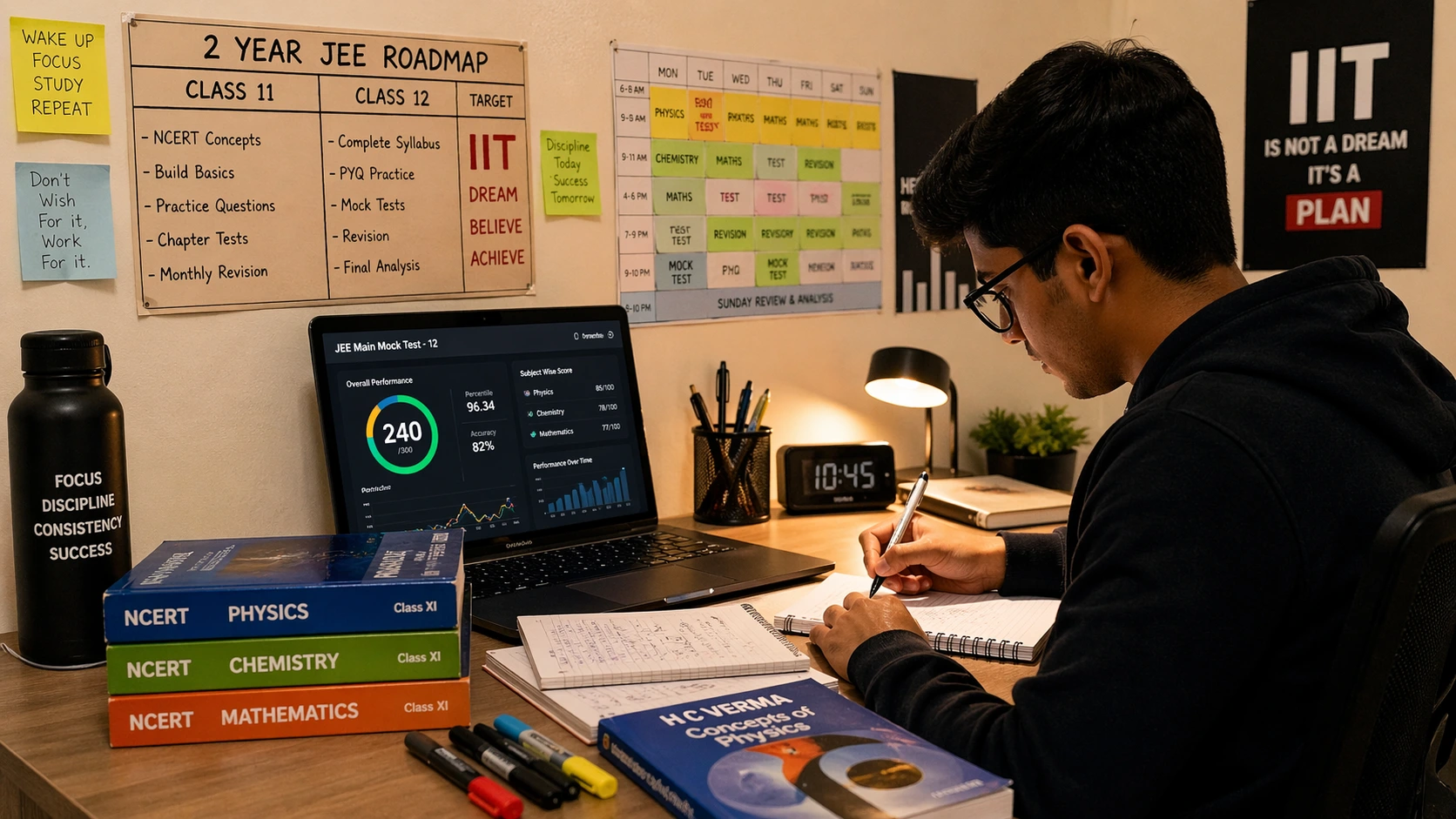
JEE Preparation Roadmap 2026 for Beginners (Class 11) – 2 Year Strategy to Crack IIT
JEE Preparation Roadmap for Beginners
Step-by-Step Guide 2026
For Class 10 Passouts & Class 11 Starters | 2-Year Strategy | Updated 2026
JEE Main and Advanced are India's most competitive engineering entrance exams. Lakhs of students appear every year. Only those with early, structured planning make it to IIT.
This guide is for students who want to know how to start JEE preparation from zero. Whether you just passed Class 10 or started Class 11, this complete roadmap covers everything step by step.
Understanding the JEE Exam Structure
JEE has two stages. JEE Main is the gateway to NITs and IIITs. JEE Advanced is the gateway to IITs. Both test Physics, Chemistry, and Mathematics.
JEE Main has 90 questions across three subjects. JEE Advanced is more conceptual with multi-correct and numerical type questions. Syllabus coverage for both is largely shared.
JEE Preparation Roadmap for Beginners (Step-by-Step)
STEP 1 Build a Strong NCERT Foundation
Start with NCERT textbooks for Class 11. Focus on concept clarity, not memorization. Every JEE topic has its roots in NCERT. Skip this and you will struggle later.
STEP 2 Create a 2-Year Preparation Strategy
Divide your JEE roadmap into two phases. Class 11 covers the full syllabus once. Class 12 covers board topics plus deep revision. This 2-year preparation strategy is non-negotiable for serious aspirants.
STEP 3 Follow a Daily Study Schedule
Beginners should study 6 to 8 hours daily. Rotate subjects every session to avoid burnout. Fix weekly targets and stick to chapter-wise planning to track progress consistently.
STEP 4 Practice PYQs and Mock Tests
Start solving previous year questions after completing each chapter. Take a full mock test every week from Class 12 onwards. Analyse your performance after every test without skipping it.
STEP 5 Revision and Backlog Management
Revise every topic once a week. If you skip revision, backlog builds fast. Address weak topics immediately. A consistent revision cycle separates toppers from average performers.
Subject-Wise Strategy for JEE Beginners
P Physics
Focus on understanding concepts first, then solve numericals. Mechanics and Electrostatics are high-weightage topics. H.C. Verma is the standard reference after NCERT.
C Chemistry
NCERT is sufficient for most of Inorganic and Organic theory. Physical Chemistry needs numerical practice. Never skip reaction mechanisms. They are directly tested in JEE Main.
M Mathematics
Mathematics is 100% practice-based. Solve at least 20 to 30 problems per chapter. Calculus, Algebra, and Coordinate Geometry are the three high-priority areas for JEE beginners.
2-Year JEE Preparation Timeline
Class 11 (Months 1 to 6)
Complete Physics and Mathematics basics. Start Organic Chemistry theory. Monthly goals: finish 2 chapters per subject per month with NCERT and one reference book.
Class 11 (Months 7 to 12)
Cover the remaining Class 11 syllabus. Begin solving PYQs topic-wise. Start attempting short mock tests of 30 minutes at the chapter level.
Class 12 (Months 1 to 8)
Complete Class 12 syllabus alongside board preparation. Increase mock test frequency to once a week. Begin performance analysis after every test seriously.
Final Revision Phase (Months 9 to 12)
Only revise. No new topics. Focus on formula sheets, short notes, and full-length mock tests every 3 days. Target weak areas aggressively during this phase.
Common Mistakes Beginners Must Avoid
• Skipping NCERT and jumping to advanced books too early
• Not maintaining a revision cycle for completed chapters
• Ignoring mock tests or not analysing results after tests
• Poor time management leading to backlog in multiple subjects
• Studying without weekly targets or a structured plan
Coaching vs Self-Study for JEE Beginners
Coaching provides structured syllabus coverage, expert doubt resolution, test series, and peer competition. It is best for students who need accountability and a guided subject-wise strategy.
Self-study works well for disciplined students with strong basics. It requires a self-designed daily study schedule, quality books, and a reliable test series for mock test practice.
Most JEE toppers combine both. They attend coaching for concept clarity and supplement it with self-study for practice and revision.
JEE Preparation in Aligarh: A Local Perspective
Students in Aligarh often ask about offline coaching vs self-study. The right guidance at the right time makes a real difference, especially in Class 11 when foundations are built.
If you are looking for JEE coaching in Aligarh for beginners, choose an institute that offers structured batch programs, regular test series, and personal mentoring. Affordable JEE coaching in Aligarh is available for Class 11 students who want to start early and build a strong foundation before Class 12.
Daily Routine for JEE Aspirants (Beginner-Friendly)
Time Slot Activity
Morning (6 to 9 AM) New concept learning from reference books or NCERT
School + Break Attend classes, take light revision notes
Afternoon (4 to 7 PM) Solve problems and previous year questions (PYQs)
Evening (8 to 10 PM) Revision and formula sheet review
Weekend (2 Hours) Full-length mock test and result analysis
Sunday Evening Weekly target review and backlog check
Frequently Asked Questions
Q: Can a beginner crack JEE in 2 years?
Yes. A focused 2-year preparation strategy starting from Class 11 is ideal. Consistent daily study, regular mock tests, and strong revision habits are the key factors.
Q: How many hours should I study daily for JEE?
Beginners should target 6 hours daily in Class 11 and scale up to 8 to 10 hours in Class 12. Quality and consistency matter more than raw hours.
Q: Is NCERT enough for JEE beginners?
NCERT is essential but not sufficient alone. It builds the foundation. After NCERT, students need H.C. Verma for Physics, NCERT Exemplar for Chemistry, and R.D. Sharma or Cengage for Mathematics.
Q: Can I prepare for JEE without coaching?
Yes, but you need strong self-discipline, a well-planned daily study schedule, quality books, and a reliable online test series. Many students crack JEE Main through self-study at home.
Q: What is the best time to start JEE preparation?
Right after Class 10 results. Starting in Class 11 gives you 2 full years for syllabus coverage, practice, and revision. Starting later makes the same preparation much harder.
Conclusion
Cracking JEE is not about studying more. It is about studying smarter with a clear roadmap. Start with NCERT, follow a daily schedule, solve PYQs regularly, and never skip revision.
Your 2-year preparation strategy begins today, not tomorrow.
Ready to Crack JEE? Start Today.
If you are in Aligarh and want expert guidance, join our JEE coaching program today.
Structured batches for Class 11 and 12 beginners. Limited seats available.