
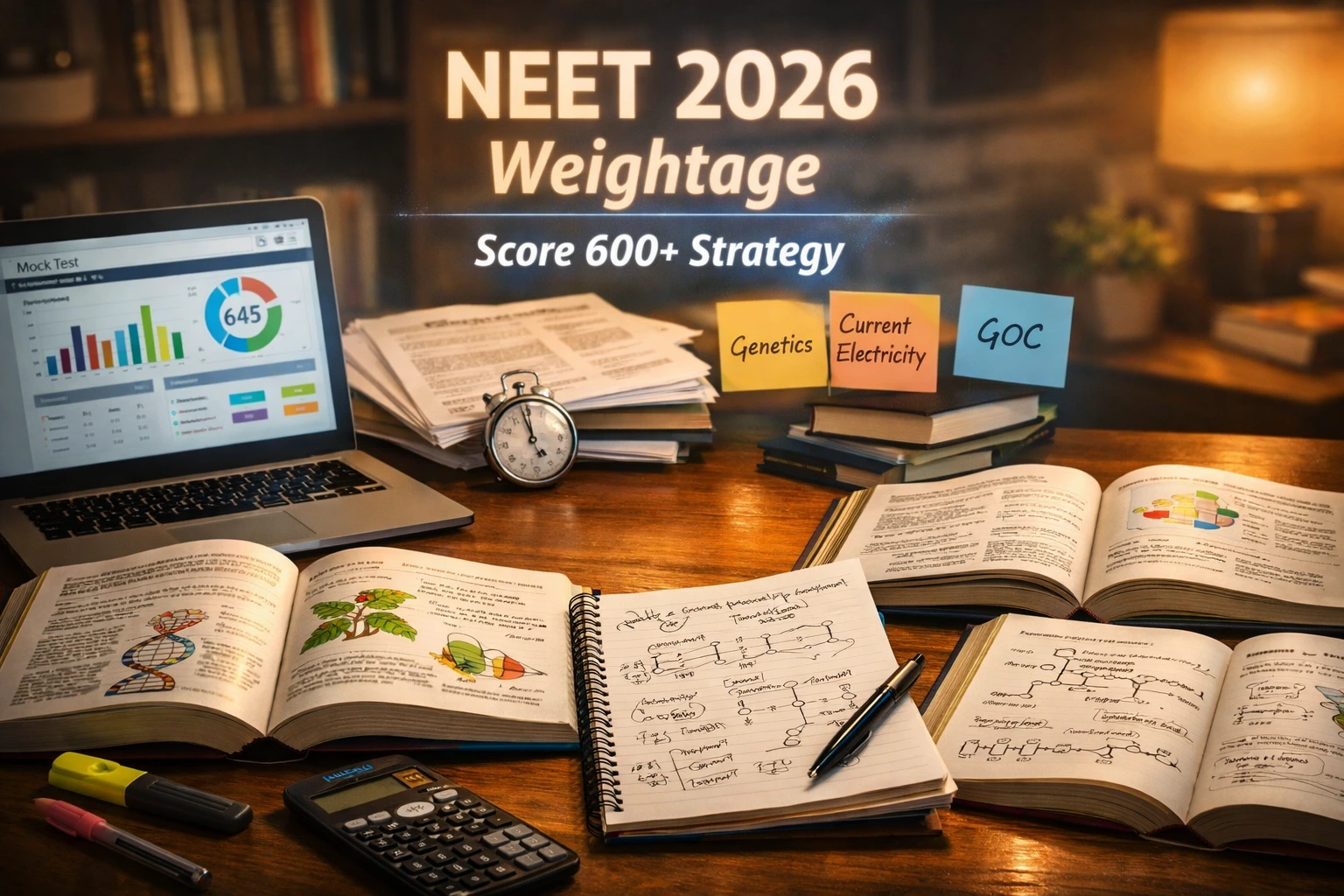
NEET 2026 Syllabus Chapter Wise Weightage (Latest Analysis)
Planning to crack NEET 2026? Then understanding the chapter-wise weightage is not optional—it’s one of the smartest ways to boost your score efficiently. Instead of studying everything blindly, you focus on what actually matters.
This guide gives you a clear breakdown of subject-wise weightage, important chapters, trends from previous years, and a smart preparation strategy to help you aim for 600+.
NEET 2026 Overview
NEET (National Eligibility cum Entrance Test) is conducted by the National Testing Agency (NTA) for admission into MBBS, BDS, AYUSH, and other medical courses.
The exam is held in offline mode (pen and paper) and lasts for 3 hours and 20 minutes. It includes 180 questions across Physics, Chemistry, and Biology (Botany + Zoology), carrying a total of 720 marks. Every correct response earns +4 points, whereas each incorrect response subtracts 1 point.
Biology holds the highest weightage with 360 marks (50% of the paper), making it the most important subject for scoring high.
NEET 2026 Syllabus – What to Expect
The syllabus for NEET 2026 is based entirely on NCERT Class 11 and 12 textbooks. As of now, no official reduction has been announced by NTA.
However, since NCERT underwent rationalization in recent years, deleted topics are unlikely to appear in the exam. No new chapters have been added either.
Key takeaways
• Equal weightage from Class 11 and 12
• NCERT is the most important source
• Focus on clarity, not extra books
Pro Tip: If it’s not in NCERT, it’s usually not worth your time.
Biology Chapter Wise Weightage (360 Marks)
Biology is divided into Botany and Zoology, both carrying nearly equal importance.
According to trends from previous years, the chapter on Genetics & Evolution is the most significant, accounting for approximately 7–9 questions. Human Physiology follows closely with 6–8 questions, making it another high-scoring area. Ecology & Environment generally provides 5–6 questions and is regarded as one of the simpler scoring sections
Reproduction (both plant and human) also plays a major role with around 5–6 questions. Plant Physiology and Cell Biology usually contribute 4–5 questions each. Other chapters like Biomolecules, Biotechnology, Biodiversity, Animal Kingdom, and Microbes contribute fewer questions but should not be ignored.
High-Weight Chapters in Biology
• Genetics & Evolution
• Human Physiology
• Ecology
• Reproduction
• Cell Biology
These chapters alone can cover a major portion of your Biology marks.
Important Tip: Many students ignore Botany, but it can easily contribute 80–90 marks. Don’t skip it.
Chemistry Chapter Wise Weightage (180 Marks)
Chemistry is categorized into three sections: Organic, Inorganic, and Physical Chemistry.
Organic and Inorganic Chemistry each contribute around 35%, while Physical Chemistry contributes around 30%.
General Organic Chemistry (GOC) and reaction mechanisms are the foundation of organic chemistry and are extremely important. Coordination Compounds is one of the most consistent chapters, usually contributing 3–4 questions every year.
Chemical Bonding is another high-value topic that helps in multiple chapters. The p-block elements, Equilibrium, Thermodynamics, and Electrochemistry also carry strong weightage.
Other chapters like Solid State and Solutions contribute fewer questions but are relatively easy to cover.
High-Weight Chapters in Chemistry
• GOC & Reaction Mechanisms
• Coordination Compounds
• Chemical Bonding
• p-Block Elements
• Equilibrium
Physics Chapter Wise Weightage (180 Marks)
Physics is often the toughest section for NEET aspirants, but it becomes manageable with smart chapter selection.
Modern Physics is one of the easiest and most scoring areas, contributing around 4–5 questions consistently. Current Electricity is another reliable chapter with direct formula-based questions.
Optics (both ray and wave) also carries significant weightage and is relatively straightforward once concepts are clear.
Mechanics, encompassing Laws of Motion along with Work, Energy & Power, offers a fair amount of questions but can be challenging. Electrostatics, Thermodynamics, Oscillations, and Rotational Motion also appear regularly.
High-Weight Chapters in Physics
• Modern Physics
• Current Electricity
• Optics
• Laws of Motion
• Electrostatics
Previous Year Trends (2019–2024)
Analyzing past NEET papers gives clear patterns
Biology: Genetics, Human Physiology, and Ecology appear every year and dominate the paper.
Chemistry: Organic chemistry and Coordination Compounds consistently contribute a large share of questions.
Physics: Modern Physics and Current Electricity are the most reliable scoring areas.
Trend Shift: After 2022, questions in Physics and Chemistry have become more application-based, while Biology still focuses heavily on NCERT lines.
Most Important Chapters for NEET 2026
If you want maximum results with minimum time, start with these
Biology: Genetics, Physiology, Ecology, Reproduction
Chemistry: GOC, Coordination Compounds, Chemical Bonding
Physics: Modern Physics, Current Electricity, Optics
These chapters together can cover around 70–75% of the paper.
Smart Preparation Strategy
1. Follow Priority Order
Always study in this order
High weight → Medium weight → Low weight
Spend the majority of your time on high-weight chapters first.
2. Study Method
• Start with NCERT reading
• Solve NCERT questions immediately
• Practice PYQs (Previous Year Questions)
• Revise regularly
PYQs are extremely important—they show the actual exam pattern.
3. Mock Test Strategy
• Start full mocks after completing 70% syllabus
• Spend more time analyzing than attempting
• Track weak chapters
Progress stems from evaluation, rather than merely administering exams.
4. Exam Time Strategy
• Start with Biology (build confidence)
• Then Chemistry
• End with Physics
Do not spend more than 2–3 minutes on a single question.
90-Day Study Plan
Phase 1 (Days 1–30): Complete all high-weight chapters with NCERT
Phase 2 (Days 31–60): Medium chapters + PYQs + weekly mocks
Phase 3 (Days 61–90): Full revision + frequent mock tests
Daily Study Plan (8–9 Hours)
• Biology: 3 hours
• Chemistry: 2.5 hours
• Physics: 2.5 hours
• Revision/Analysis: 1 hour
FAQs
Is the syllabus reduced?
No official reduction has been announced.
Which subject has highest weightage?
Biology (360 marks).
Is NCERT enough?
Biology: Yes
Chemistry: Mostly
Physics: Needs practice beyond NCERT
How to score 600+?
Strong Biology (300+), balanced Chemistry & Physics.
Conclusion
Cracking NEET 2026 is not about studying everything—it’s about studying smart.
Focus on high-weight chapters, stick to NCERT, practice PYQs, and take regular mock tests. Students who score 650+ are not the ones who study the most—they are the ones who study the right topics deeply.
Begin with Genetics, establish your Chemistry fundamentals, and achieve Physics scores by focusing on Modern Physics and Current Electricity
Consistency is the real game-changer.